




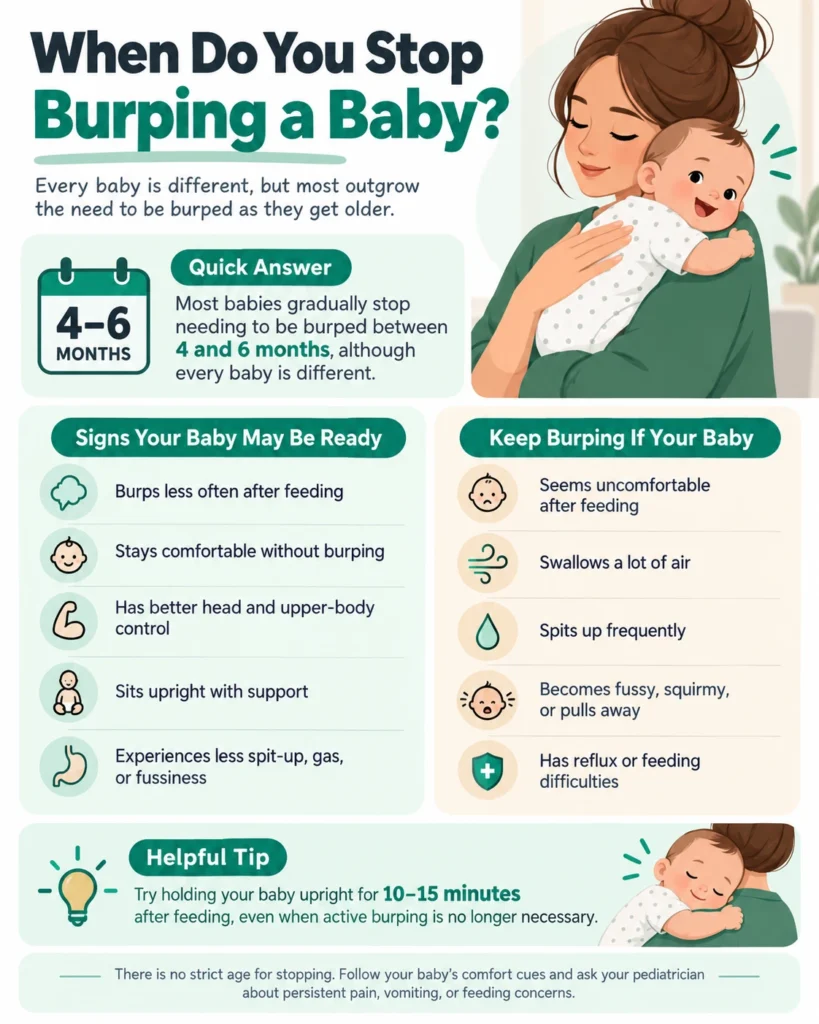
Many babies need less help burping by about 4 to 6 months, but there is no medically required age to stop. Your baby’s behavior after feeding is more useful than the calendar. If feeds remain comfortable and your baby settles without burping, you can gradually stop making it part of every feeding.
Continue burping when your baby gulps, pulls away, becomes fussy during a feed or seems uncomfortable afterward. Babies born prematurely and those with reflux, feeding difficulties or certain medical conditions may benefit from help for longer. Follow your pediatrician’s advice when your baby has an individual feeding plan.
Why Babies Need Help Burping
Babies can swallow air while nursing or drinking from a bottle. That air takes up space in the stomach and may contribute to fullness, fussiness or spit-up. A feeding pause and change of position can slow gulping and give swallowed air an opportunity to escape.
Burping is most useful during the early months, when babies are still coordinating sucking, swallowing and breathing. As feeding becomes more efficient and babies spend more time upright, many release swallowed air without as much assistance.
Burping isn’t a treatment for every unsettled period after a meal. Hunger, overfeeding, fast milk flow, reflux, fatigue and illness can produce similar behavior.
Is 4 to 6 Months the Right Time to Stop?
The 4- to 6-month range is a practical estimate, not a firm pediatric cutoff. The American Academy of Pediatrics does not set a specific age at which all parents should stop burping. Its guidance focuses on feeding technique and the baby’s response.
Some babies need little help by 3 or 4 months, while others continue beyond 6 months. Changes that may reduce the need include:
- Better coordination during breast or bottle feeding
- Slower, less frantic feeding
- More time spent upright with stronger head and trunk control
- The ability to change position independently
Starting solids does not automatically mean burping should stop. Breast milk or formula remains an important part of feeding throughout the first year, and a baby can still swallow air during those feeds.
Signs Your Baby May Be Ready to Stop Burping
Look for a pattern across several days. One feed without a burp does not prove your baby is finished with burping, just as one fussy evening does not mean they still need it after every meal.
| Your baby may need less help | Your baby may still benefit from burping |
| Feeds calmly without repeated gulping | Gulps, coughs or repeatedly pulls away |
| Settles comfortably after eating | Becomes fussy during or soon after feeds |
| Does not spit up more when a burp is skipped | Spits up noticeably more when burping is skipped |
| Often releases air without assistance | Appears relieved after burping |
| Rarely burps after several gentle minutes | Arches, squirms or draws up their legs after eating |
These are clues, not a diagnostic checklist. Back arching, crying and feeding refusal can also accompany reflux or another feeding problem.
How to Stop Burping Gradually
You do not need to stop all at once. A short trial helps you see whether burping is still doing useful work.
Remove one routine burping pause
If you normally burp halfway through and at the end, allow your baby to continue feeding until they naturally pause. Keep the end-of-feed burp for now.
A natural pause may be a better opportunity than interrupting a baby who is feeding comfortably.
Test one relaxed daytime feed
Choose a calm daytime feeding. Afterward, hold your baby comfortably upright without repeatedly patting and observe their response.
Watch what happens afterward
Look for unusual fussiness, discomfort or increased spit-up. If your baby stays comfortable, try the same approach during another feed.
Keep burping available when needed
A baby may swallow more air during a hurried feeding, after crying or while adjusting to a different bottle nipple. Resume burping and test again later if discomfort repeatedly returns.
How Long Should You Try to Burp a Baby?
You do not need to pat indefinitely while waiting for a sound. Experts advise that if a baby has not burped after several minutes, parents can continue the feeding rather than worry. Babies do not burp after every attempt. Try a comfortable position for a few minutes:
- Over the shoulder: Hold your baby upright while supporting the head and back, then gently rub or pat the back.
- Sitting on your lap: Support the baby’s chest and head with one hand and gently pat the back with the other.
- Across your lap: Lay the baby face down across your thighs with the head supported above the chest, then rub or gently pat the back.
Hard or rapid patting is unnecessary. If no burp comes and your baby looks comfortable, there may be little air to release.
Do Breastfed Babies Need to Be Burped?
Some breastfed babies swallow relatively little air and may not need to burp at every feeding. The AAP suggests offering a burp when switching breasts while noting that some nursing babies may not need to burp.
A breastfed baby may need more help when milk lets down quickly, the baby gulps or coughs, the latch repeatedly breaks, or the baby appears uncomfortable afterward.
If a fast letdown, painful latch, clicking or frequent coughing makes feeds difficult, ask a pediatrician or qualified lactation professional to assess the feeding.
What About Bottle-Fed Babies?
Bottle-fed babies may swallow more air when nipple flow is too fast or feeding continues after they signal a pause.
The AAP suggests burping a bottle-fed baby after approximately every 2 to 3 ounces during the early months. This is a starting point, not a reason to interrupt a baby feeding slowly and comfortably.
To reduce gulping:
- Use a nipple flow that matches your baby’s feeding ability.
- Keep your baby supported and milk in the nipple.
- Pause when your baby stops sucking, turns away or shows another fullness cue.
- Don’t encourage your baby to finish after signaling they are done.
Changing formula solely because of gas is not usually the first step. Discuss formula changes, thickened feeds or possible allergies with your pediatrician.
When Can You Stop Burping a Baby at Night?
You can consider reducing nighttime burping when your baby feeds calmly, stays comfortable without it and returns to sleep without increased spit-up or fussiness. Start with one quiet nighttime feed rather than changing every feed at once.
There is no benefit in waking a comfortable sleeping baby solely to produce a burp. If your baby falls asleep after feeding and does not burp after a few gentle minutes upright, return them to a safe sleep space.
Continue nighttime burping for fast feeds, recurring discomfort, troublesome reflux or an individualized medical feeding plan. The adult holding the baby upright must remain awake; never fall asleep together on a couch, armchair or adult bed.
Does Spit-Up Mean Your Baby Still Needs Burping?
Not necessarily. Spit-up often happens because an infant’s stomach is small and the muscle between the stomach and esophagus is still developing. A full stomach or movement soon after feeding can bring milk back up even when little swallowed air is present.
Normal spit-up usually flows out easily and does not distress the baby. Vomiting is more forceful and typically involves abdominal muscle contractions.
If spit-up increases after you stop burping, try adding an end-of-feed burp again and keeping your baby calmly upright for 10 to 15 minutes. Avoid pressure on the belly and delay active play or tummy time immediately after feeding.
Burping may reduce spit-up associated with swallowed air, but it cannot prevent all reflux.
Safe Sleep Still Comes First
A baby who spits up should still be placed on their back on a separate, firm, flat sleep surface. Do not elevate the crib mattress or use wedges, positioners or inclined sleepers. The AAP states that even babies with reflux or GERD should sleep flat on their backs. Holding a baby upright is an awake, supervised activity. Move the baby to an appropriate crib, bassinet or play yard for sleep.
Frequently Asked Questions
Can I stop burping my baby at 3 months?
Some 3-month-olds feed comfortably without routine burping, but many still benefit from it. Try reducing one burping pause and watch your baby’s comfort. Resume if fussiness, gulping or increased spit-up repeatedly follows.
Should I burp my baby if they fall asleep while feeding?
You can hold your baby upright and gently offer a burp without vigorous patting. If no burp comes after a few minutes and the baby remains comfortable, place them in their own safe sleep space rather than keeping them awake to force one.
Is it OK to put a baby down without burping?
Yes, if the baby has fed comfortably and appears settled. Babies do not burp after every feeding. Always put an infant down on their back on a firm, flat sleep surface.
Does starting solid food mean I can stop burping?
Not automatically. Babies may swallow less air with spoon-fed solids, but they still receive breast milk or formula and may need burping after those feeds.
Can a baby burp on their own?
Yes. As babies develop stronger head and trunk control and spend more time upright, many release swallowed air without being patted. A spontaneous burp is one sign that routine assistance may be becoming less necessary.
There is no milestone your baby must reach before you stop burping. Reduce it gradually, follow your baby’s comfort, and bring it back temporarily when a hurried or difficult feeding leads to more swallowed air.
