




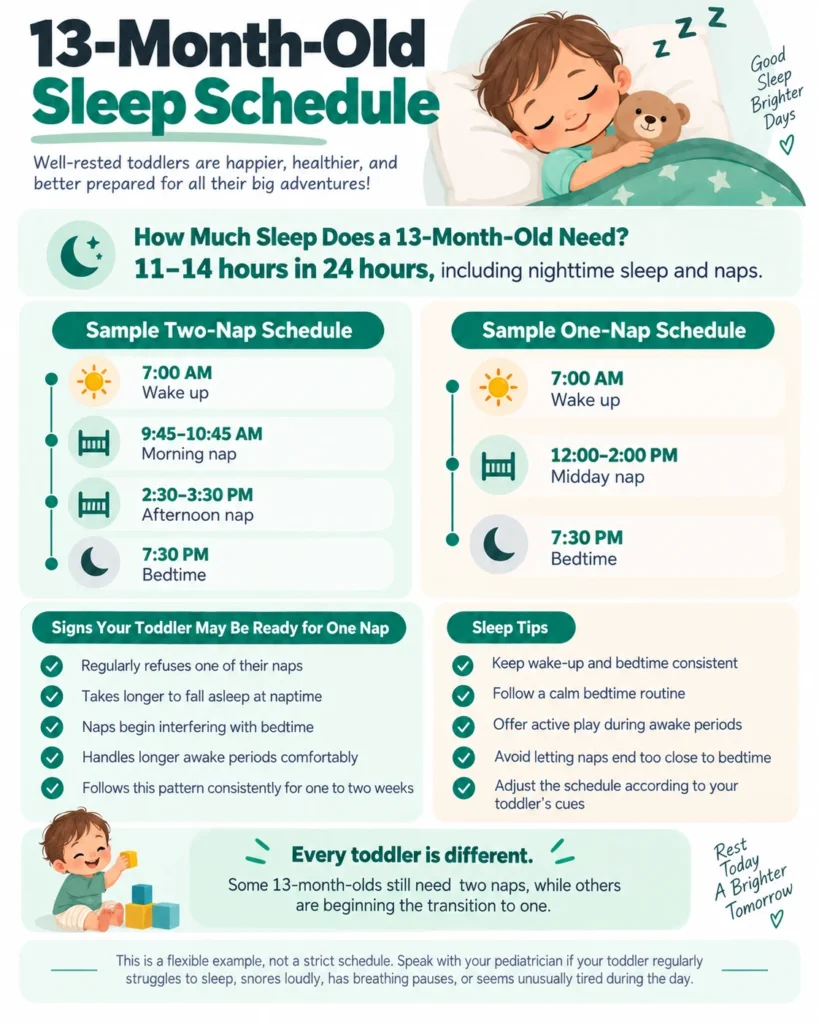
A practical 13-month-old sleep schedule usually includes 11–14 hours of total sleep in 24 hours, counting naps. Some toddlers still take two naps, while others are beginning the move to one. A typical day might start around 7:00 a.m. and end with bedtime between 7:00 and 8:00 p.m., but the best timing depends on your child’s nap pattern and sleep needs.
The goal isn’t to force a particular timetable. It is to create a predictable rhythm with enough opportunities to sleep.
Two Nap Schedule for a 13-Month-Old
If your toddler still gets tired after a few hours of being awake, stick with two naps. A typical two nap schedule for a 13 month old keeps wake windows right around 3 to 3.5 hours.
| Time | Activity |
| 6:30 AM | Wake up |
| 9:30 AM | Nap 1 (1 to 1.5 hours) |
| 11:00 AM | Wake up and eat lunch |
| 2:30 PM | Nap 2 (1 hour) |
| 3:30 PM | Wake up and play |
| 7:30 PM | Bedtime routine begins |
| 8:00 PM | Asleep for the night |
One Nap Schedule for a 13-Month-Old
If your toddler is successfully staying awake for longer stretches, you can transition to a single, longer midday nap. A one nap schedule for 13 month old toddlers stretches the morning wake window to about 4.5 or 5 hours. Because daylight sleep is consolidated, bedtime often needs to shift slightly earlier so they do not become overtired in the evening.
| Time | Activity |
| 6:30 AM | Wake up |
| 11:30 AM | Lunch |
| 12:00 PM | Nap (2 to 2.5 hours) |
| 2:30 PM | Wake up and play |
| 6:45 PM | Bedtime routine begins |
| 7:15 PM | Asleep for the night |
Signs It Is Time to Drop a Nap
Adjusting a 13 month old nap schedule requires watching your child’s behavior rather than strictly watching the clock. Your toddler might be ready to drop their morning nap if you notice the following patterns for at least a week:
- Refusing the afternoon nap: They sleep well in the morning but fight the afternoon nap entirely, pushing bedtime later.
- Taking a long time to fall asleep: They spend 30 to 45 minutes playing or babbling in the crib before finally falling asleep for their morning nap.
- Early morning wakings: They begin waking up at 4:30 AM or 5:00 AM, signaling that they are getting too much daytime sleep.
The transition from two naps to one rarely happens overnight. Expect a few weeks of fluctuation where your child needs one nap on some days and two naps on others.
Early in the transition, the nap may need to begin around 11:30 a.m. An earlier bedtime can help when the nap ends sooner than expected.
Nemours KidsHealth notes that young toddlers may still take two naps and that most consolidate to one by around 18 months, sometimes sooner. A 13-month-old who still sleeps well twice a day is not behind.
How to Move From Two Naps to One Without Rushing
Dropping a nap all at once can leave a toddler awake much longer than they can comfortably manage. A gradual adjustment is usually easier to evaluate.
Move the morning nap later in small steps
Shift the first nap 15 minutes later every few days. As it approaches midday, the second nap may disappear naturally. After a short midday nap, bring bedtime forward instead of stretching your toddler to the usual time.
Use a short bridge nap when necessary
If your toddler wakes early from the first nap and cannot reach bedtime comfortably, a brief late-afternoon nap may help. If it repeatedly delays bedtime, use an earlier bedtime instead.
Keep the morning active but not exhausting
Morning daylight, outdoor movement, meals, and calm play can support a predictable rhythm. Don’t keep an exhausted child awake through intense stimulation simply to reach a target time.
Expect some back-and-forth
A nap transition rarely follows a straight line. Watch the overall pattern rather than restarting the plan after one irregular day.
How Wake Windows Fit Into the Schedule
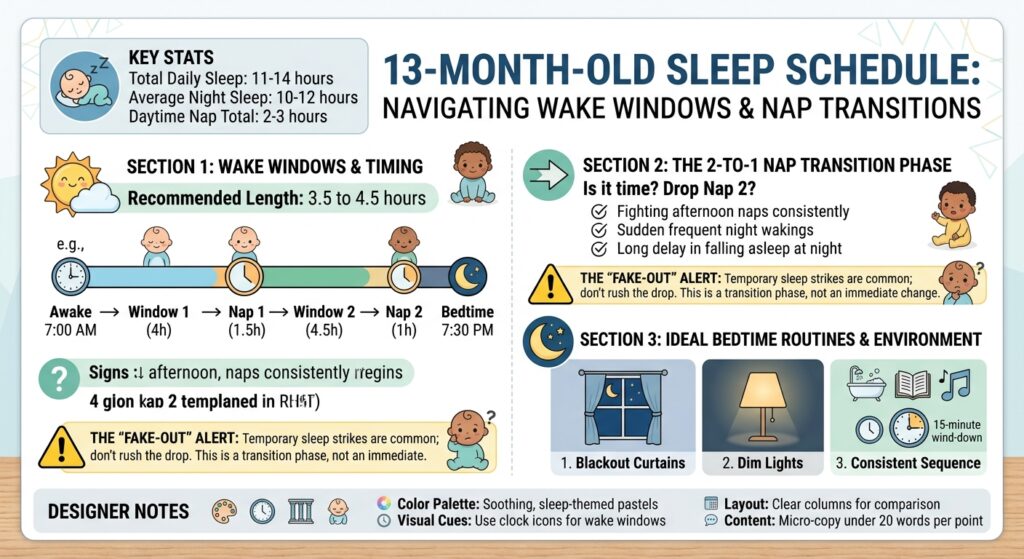
A wake window is simply the period between waking and the next sleep. It can help parents estimate nap timing, but it is not a medical requirement or an exact biological timer.
On a two-nap schedule, awake periods are shorter than on a one-nap schedule. Use the clock together with behavior. Early tired signs can include becoming quieter, losing interest in play, seeking extra contact, rubbing the face, or becoming clumsy.
If your child cheerfully spends 20–30 minutes awake before every nap, it may be scheduled too early. If they fall asleep during lunch or unravel well beforehand, it may be too late. Adjust one sleep period by about 15 minutes and observe for several days.
Build a Bedtime Routine That Works With the Schedule
A schedule offers time for sleep; a routine signals that the day is ending. Keep it calm, familiar, and easy to repeat.
One simple sequence is:
- Finish milk or the evening snack.
- Take a bath or wash hands and face.
- Put on pajamas and a sleep sack, if used safely.
- Brush teeth.
- Read one or two short books.
- Dim the lights, say the same goodnight phrase, and place your toddler in the crib.
The American Academy of Pediatrics’ “Brush, Book, Bed” guidance encourages toothbrushing, shared reading, and a regular bedtime. Keep lively games, bright screens, and household excitement outside the final part of the routine. Consistency matters more than complicated steps.
Why a Previously Good Sleeper May Suddenly Struggle
Parents often call any difficult period a “13-month sleep regression,” but that phrase is not a medical diagnosis and does not identify a single cause.
Sleep can become unsettled around this age because:
- The two-to-one nap transition is beginning.
- Walking, climbing, or language practice is absorbing your toddler’s attention.
- Separation anxiety makes leaving at bedtime harder.
- Teething or a minor illness causes discomfort.
- Travel, childcare, or family routines have changed.
- A late or long nap has reduced sleepiness at bedtime.
- Hunger, room temperature, noise, or light is interrupting sleep.
Before changing the schedule, look for the simplest explanation. Congestion, apparent pain, or poor eating points to a health concern rather than merely a timing problem.
Troubleshooting Common Sleep Problems
The second nap is getting later
Cap or move the morning nap earlier before dropping it completely. This may preserve enough space for the second nap and a reasonable bedtime.
One nap lasts only 30–45 minutes
The transition may be happening too early, or the nap may begin after your child is already overtired. Try moving it slightly earlier and use an early bedtime that evening.
Your toddler wakes before 6:00 a.m.
Check total sleep across the day. Morning light, hunger, noise, overtiredness, or a poorly timed first nap can contribute. Keep the room dark and avoid shifting the first nap dramatically after one early wake-up.
Bedtime takes a long time
If your toddler is content in the crib, bedtime may be too early; if distressed and exhausted, it may be too late. Move bedtime by 15 minutes and observe for several days.
Night waking has increased
Check for illness, teething discomfort, temperature, or another physical need. Keep nighttime interactions dim and quiet. If waking persists, a weeklong sleep log may reveal a timing pattern.
Sleep-Space Safety at 13 Months
Continue following the instructions and limits for your toddler’s crib and mattress. Use a firm, tight-fitting mattress with a fitted sheet, keep cords and monitor cables out of reach, and keep the crib mattress at its lowest appropriate position.
Do not add crib bumpers or use weighted sleep products. Avoid large items that your toddler could use as a step to climb over the rail.
If your child can climb out, has reached the crib manufacturer’s height limit, or the rail no longer provides safe containment, follow the manufacturer’s instructions and discuss the move to a toddler bed with your pediatrician.
Frequently Asked Questions
How many naps should a 13-month-old take?
A 13-month-old may take one or two naps. Two naps remain appropriate when your toddler falls asleep readily and bedtime still works. One nap may fit better when a nap is consistently refused or two naps repeatedly delay bedtime.
What time should a 13-month-old go to bed?
Many 13-month-olds go to bed between 7:00 and 8:00 p.m., but bedtime should reflect wake time, nap length, and total sleep. A child who wakes at 6:00 a.m. or takes a short midday nap may need an earlier bedtime.
How long should a 13-month-old nap?
Total daytime sleep commonly falls around one to three hours, divided between one or two naps. The more useful measure is whether your child gets 11–14 total hours and appears rested during the day.
Is 13 months too early for one nap?
Not necessarily. Some toddlers are ready, but many still need two naps. Look for consistent nap refusal and comfortable longer awake periods rather than switching because of age alone.
Should I wake my toddler from a nap?
Waking may help when a late or long nap repeatedly prevents bedtime sleep. However, routinely cutting naps can leave a child overtired. Make small changes and evaluate the result over several days.
Why is my 13-month-old suddenly waking at night?
Possible reasons include nap changes, separation anxiety, teething, illness, new developmental skills, discomfort, or a routine change. Persistent snoring, breathing difficulty, pain, or unusual daytime sleepiness deserves medical advice.
