




To choose a daycare, first confirm the program is licensed and check its inspection history. Then tour your top options in person while the classrooms are busy. On each tour, ask about security, health policies, staff ratios and training, daily routines, discipline, meals, and how the center keeps in touch with parents. The answers, together with what you see in the rooms, will tell you far more than a brochure.
Most of these questions work for licensed home daycares as well as centers.
Key Takeaways
- Check licensing and inspection reports before you tour, and visit mid-morning when the classrooms are active.
- Ask for the staff-to-child ratio in your child’s specific room. National standards call for no more than 3 infants or 4 toddlers per caregiver.
- Someone certified in pediatric CPR and first aid should be on site at all times, and every employee should pass a fingerprint-based background check.
- Infants should sleep on their backs in a bare crib, and bottles should never be propped.
- You should be able to visit your child anytime without an appointment.
- How teachers treat the children matters more than how nice the building looks.
Before the Tour: Narrow Your List
Before you visit anywhere, rule out programs that don’t meet the basics.
Start with licensing. Confirm the program is licensed by your state, then look up its inspection reports and any past violations on your state’s child care licensing website. Childcare.gov can point you to your state’s search tool.
Next, check hours and location. The schedule needs to cover your workday with some buffer. The drive also has to be realistic at rush hour, since a route that’s easy on a quiet weekend may not be on a weekday morning.
Then look at cost. Ask for the full fee schedule, including waitlist deposits, registration fees, late pickup charges, and whether meals and supplies cost extra. In some areas, infant spots fill up months ahead, so join waitlists early if you need care for a baby.
Once a program clears these checks, schedule a tour. Mid-morning is usually the best time to go, because you’ll see the room in full swing rather than at nap time.
The Environment: Security, Cleanliness, and Space
When you walk in, take a minute to notice how the place feels before you pull out your list. Classrooms should look clean and cared for, with toys and children’s artwork at their eye level.
How secure is the building?
Look for locked entrances, key fobs or PIN codes for parents, and a clear sign-in and sign-out process. Ask who’s allowed to pick up a child and how staff confirm the identity of a relative or friend they haven’t met.
How often are toys and surfaces sanitized?
Ask about the daily cleaning schedule. High-touch surfaces and toys that children put in their mouths should be sanitized at least once a day, and often more.
Are the play areas right for my child’s age?
Toddlers shouldn’t be climbing on equipment built for 5-year-olds. Outdoors, look for secure fencing, no obvious hazards, and some shade for hot days.
Where do the children nap?
See the sleep space for yourself. For infants, the center should follow the AAP’s safe sleep guidelines. Babies should be put down on their backs in a crib with a firm, flat mattress and nothing else in it: no bumpers, blankets, pillows, or stuffed animals.
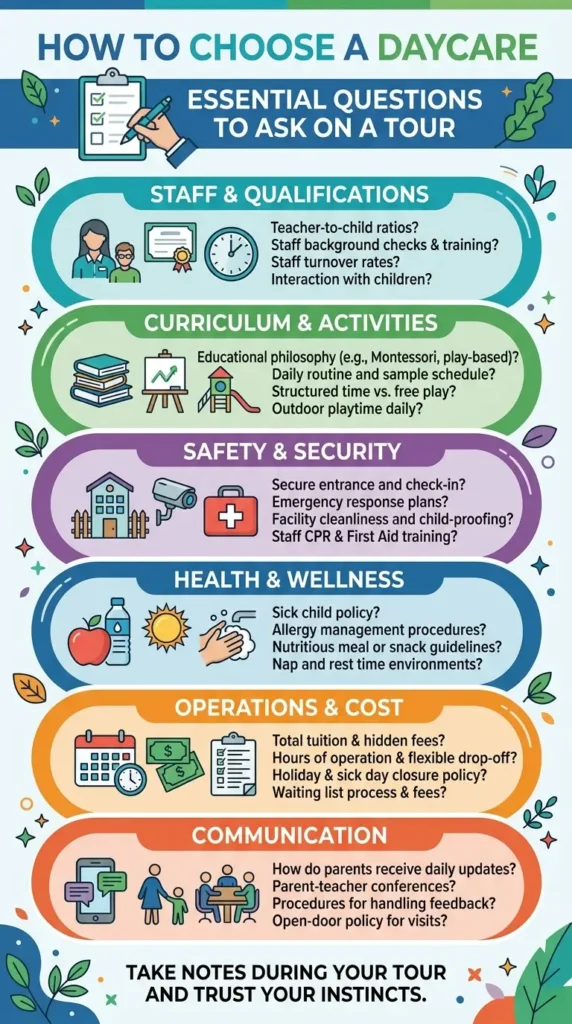
Health and Safety Policies
You’ll want to know exactly how the center handles everything from a scraped knee to a sudden fever.
What is your sick child policy?
Ask what gets a child sent home and how long they have to stay out. Common reasons include vomiting two or more times in a day, a rash along with a fever, or a fever that comes with a clear change in behavior. Many centers also use a temperature cutoff such as 100.4°F. A strict policy can be tough on a work schedule, so line up backup care before you need it. The upside is fewer illnesses going around the room.
Are your caregivers trained in pediatric CPR and first aid?
At a minimum, someone with current pediatric CPR and first aid certification should be present whenever children are there, including early drop-off and late pickup. The best answer is that every caregiver who works directly with children is certified. Ask how often certifications are renewed.
How do you handle emergencies and drills?
Ask to see the written plans for fires, severe weather, and lockdowns, and how often the children practice them.
How are medications stored and given?
If your child needs prescription medicine or an epinephrine auto-injector (such as an EpiPen), ask about the whole process. Medicines should be kept out of children’s reach, staff should be trained to give them, and every dose should be recorded in a written log.
Caregiver Qualifications and Staffing
A beautiful building means little if the caregivers are stretched thin or checked out. How staff interact with the children matters more than anything else you’ll see on the tour.
What is your staff-to-child ratio?
Ask for the ratio and group size in your child’s room, then compare them with your state’s rules and national standards. The AAP and its partners recommend no more than 3 infants per caregiver. For toddlers, they recommend no more than 4 per caregiver, in groups of 8 or fewer. Most states allow higher numbers than this, so a center that meets these ratios is likely going beyond what’s required. Fewer children per adult means more one-on-one attention.
How long have your teachers been here?
Frequent staff changes are a red flag. Ask how long the lead teacher in your child’s room has worked there and how many teachers left in the past year. Consistent caregivers help young children form secure attachments.
What background checks do employees go through?
Licensed programs must run a comprehensive check on staff and anyone else with unsupervised access to children. That check includes an FBI fingerprint check and searches of criminal, sex offender, and child abuse and neglect registries in every state the person has lived in over the past five years. Ask whether it covers cooks, custodians, substitutes, and volunteers too.
What training do your teachers have?
Look for lead teachers with a degree in early childhood education or a Child Development Associate (CDA) credential. Also ask what ongoing training the center requires each year.
Daily Routine, Curriculum, and Discipline
Young children do best with a predictable day. Learning how the center structures its time helps you see whether its approach fits your family.
Can you walk me through a typical day?
Look for a mix of structured activities, free play, outdoor time, meals, and rest. The schedule should feel engaging without being rigid.
What is your educational philosophy?
Some centers are play-based, while others follow a specific approach such as Montessori or Reggio Emilia. Ask what learning looks like, day to day, for a child your child’s age.
How do you handle discipline and challenging behavior?
Listen closely to this answer. Good answers mention positive reinforcement, redirection, and consequences that fit the child’s age. The center should have a clear written policy against physical punishment and shaming. Ask specifically how staff handle common toddler behaviors like biting.
Do children use screens here?
The AAP advises against screen time for children under 18 months, apart from video chatting. For ages 2 to 5, it recommends no more than an hour a day of high-quality programming. Ideally, a center uses no screens at all with babies and toddlers. If it does use them, ask how often, for which ages, and what the children watch.
Nutrition and Feeding
Are meals and snacks provided, and are they made on-site?
Ask for a sample weekly menu, and look for fruits, vegetables, whole grains, and lean proteins. If you’ll be packing food from home, ask what the rules are.
How do you handle food allergies?
Ask how the center prevents cross-contact and how every staff member, substitutes included, knows which children have allergies. Some centers use posted allergy lists or color-coded placemats. Some are fully nut-free, while others manage allergies child by child.
How do you feed infants?
Ask how breast milk and formula are labeled, stored, thawed, and warmed. Caregivers should hold babies during bottle feedings rather than propping the bottle, which is a choking risk. Also ask whether they feed on demand or follow your baby’s schedule.
Communication and Parent Involvement
How will I hear about my child’s day?
Many centers use parent apps such as Brightwheel or Procare to share photos and logs of meals, naps, and diaper changes. If a center doesn’t use an app, ask how it records that information and shares it at pickup.
Can I visit without an appointment?
You should be able to drop in whenever your child is there. Programs that receive federal child care subsidy funds must give parents unlimited access during operating hours. If a center insists you book visits days in advance, treat that as a serious red flag.
How do you track and share my child’s development?
A good center tracks milestones and holds formal check-ins once or twice a year to talk about your child’s progress, social skills, and any concerns.
Trust What You Saw
Once you’ve worked through your questions, think about how the visit felt. Safety and policies come first, but your impressions of the people count too.
Ask yourself:
- Did the teachers seem calm and engaged, or stressed and distracted?
- Did the children go to the adults easily for help or comfort?
- Did the director answer openly, or get defensive?
- Can you picture your child in that room?
Try to tour at least two or three programs so you have something to compare, and take notes at each one, because the details blur quickly. A good center will welcome your follow-up questions.
This guide is general information. Licensing rules, ratios, and background check requirements vary by state, so confirm the details with your state’s child care licensing agency.
