


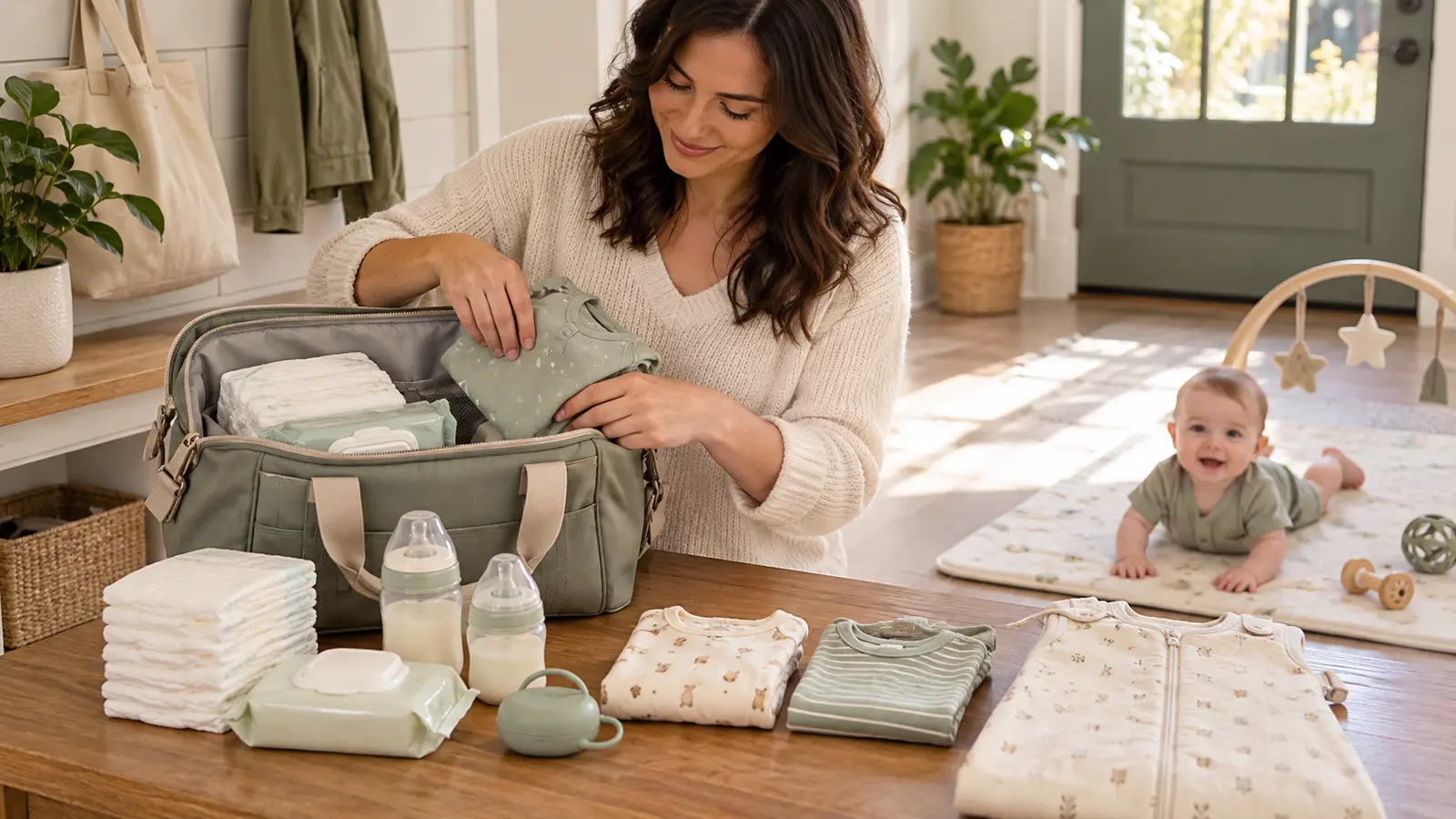

An infant daycare packing list should cover six basics: feeding supplies, diapers and wipes, spare clothing, an approved sleep item, comfort items, and any required health forms. The exact quantities depend on your baby’s age, feeding schedule, and the provider’s rules, so ask for the center’s written packing list before buying or labeling anything.
For the first day, pack enough for the full care period plus a small backup. Label every item with your baby’s name, and separate the things that travel daily from supplies that can stay in the classroom. The checklist below helps you do both without turning the daycare bag into a second nursery.
Infant daycare packing list at a glance
| Pack or confirm | Practical starting point |
|---|---|
| Bottles and milk | One labeled bottle per expected feeding, following the provider’s policy |
| Diapers | A day’s supply plus extras, or the quantity requested for the cubby |
| Wipes and diaper cream | Sealed package and labeled cream, if the center does not provide them |
| Clothing | Two or three complete, season-appropriate changes |
| Sleep item | A correctly sized wearable blanket only if the provider allows it |
| Pacifier | One or two labeled pacifiers if your baby uses them |
| Health information | Required forms, emergency contacts, allergies, and written care instructions |
| Bag | A washable, easy-to-label bag that fits the provider’s storage space |
Start with your daycare’s rules
Daycare policies vary more than most first-time families expect. One program may supply diapers and wipes, while another asks parents to bring a weekly stock. Some accept prepared bottles only; others have specific rules for frozen breast milk, formula containers, bottle caps, and labeling. Sleep sacks, pacifier clips, sunscreen, diaper cream, and medication may each require approval.
Ask these questions before the first day:
- Which supplies does tuition include?
- What must arrive every day, and what can remain in the cubby?
- How should bottles, breast milk, formula, food, clothing, and pacifiers be labeled?
- Will staff wash bottles, or must used bottles go home?
- Which sleepwear is permitted for infants?
- Do diaper cream, sunscreen, or medication require a signed authorization?
- How will staff tell you when supplies are running low?
A written answer saves money and prevents last-minute problems. It also helps you spot expenses that were not included in the advertised tuition. Our guide to the hidden costs of daycare can help you add those supplies and fees to your monthly plan.
Bottles, breast milk, and formula
Send the bottle type and nipple flow your baby already uses successfully. A busy first day is not the best time to introduce an unfamiliar bottle. Many centers ask for one prepared bottle for each expected feeding rather than a large container that staff must portion.
Label each bottle with the information required by your provider. For human milk in early care settings, federal health guidance recommends the child’s full name and the date on the container; some programs also request the feeding time or date expressed. Keep a cap over the nipple and place chilled milk in an insulated cooler with frozen ice packs if you are transporting it before refrigeration.
For formula, follow both the product directions and the center’s preparation policy. The CDC says prepared formula should be used within two hours of preparation and within one hour after feeding begins; if it will not be used within two hours, refrigerate it immediately and use it within 24 hours. Never add extra powder or water to make a bottle last longer.
If you are estimating how much formula your baby may need across the day, use our Baby Formula Calculator as a planning estimate, then adjust the number of bottles to your baby’s usual intake and your pediatrician’s guidance.
Diapers, wipes, and changing supplies
Some daycares request a small daily supply; others store a sleeve or full package. Follow the center’s requested quantity and add a few extras for bowel movements, leaks, or a longer day. Check the cubby regularly because babies can change diaper sizes quickly.
- Disposable diapers or cloth-diaper components accepted by the program
- Wipes in a resealable package
- Diaper cream in its original container
- Wet bag or plastic-free waterproof pouch for soiled clothing, if requested
- Any signed authorization required for staff to apply cream
Write your baby’s name on packages and individual reusable pieces. If you are planning your first bulk purchase, the newborn diaper planning guide can help you avoid overbuying one size.
Clothing for spills, leaks, and changing weather
Pack two or three complete outfit changes, not just extra onesies. Each set should include a top or bodysuit, bottoms, socks, and any season-appropriate layer. Choose washable clothing that is easy for caregivers to remove during diaper changes.
Review the spare clothes every week. Replace anything used, move outgrown sizes back home, and update layers when the weather changes. Put clean outfits in separate labeled pouches so staff can grab a complete set without searching through the bag. Add an empty waterproof pouch for wet or soiled clothing if the daycare does not provide one.
What to pack for infant naps
Ask what the program provides and what it permits. For babies, the American Academy of Pediatrics recommends a firm, flat sleep surface with no pillows, loose blankets, stuffed toys, bumpers, or other soft objects. A properly fitted, non-weighted wearable blanket may be used instead of loose bedding.
Do not send a blanket simply because it is comforting at home. The daycare’s infant sleep rules and current safe-sleep standards come first. If the center accepts sleep sacks, label the garment and send the correct size. Weighted sleep products should not be used for infants.
Pacifiers and comfort items
If your baby uses a pacifier, send one or two identical, labeled pacifiers in a clean case. Ask whether clips are prohibited; many programs do not allow cords or attachments because they can create safety risks. Replace pacifiers when they become damaged or too small for the manufacturer’s age range.
A familiar comfort object may help an older child, but an infant’s crib should remain bare. Ask whether a small family photo can be kept near the changing or play area instead. It offers familiarity without placing an object in the sleep space.
Medication, diaper cream, and health information
Never place loose medication in the daycare bag. Child-care programs generally require medication in its original pharmacy or manufacturer-labeled container, along with written authorization and clear administration instructions. The label should match the child’s name when prescribed. Ask the director about state rules and the program’s forms before bringing any medicine.
Provide written information about allergies, feeding needs, medical conditions, and emergency contacts. If your baby has an individualized care or emergency plan, confirm that the appropriate staff have received it. Update the paperwork whenever instructions or contact information change.
Daily bag versus cubby supplies
| Usually travels daily | May stay at daycare |
|---|---|
| Prepared bottles and milk | Diapers and wipes |
| Fresh feeding instructions | Diaper cream with authorization |
| Clean pacifier and case | Spare clothing |
| Weather-dependent outerwear | Approved sleep sack |
| Items requested for that day | Empty wet bag or supply pouch |
Your provider’s system may be different. The useful habit is to create two checklists: a short morning list for items that must leave home and a weekly restock list for the cubby. That reduces forgotten bottles without requiring you to repack every diaper each night.
How to label daycare items so they come home
- Use your baby’s full name when the center requires it.
- Choose waterproof labels for bottles and containers.
- Use laundry-safe labels or permanent fabric markers for clothing.
- Label removable bottle parts, caps, pacifier cases, and sleep sacks.
- Add the date and contents to milk exactly as the provider instructs.
- Check labels after washing and replace any that peel or become unreadable.
Avoid putting sensitive medical information on the outside of the bag. Share it through the center’s approved forms or secure communication system.
What not to send to infant daycare
Leave out anything prohibited by the program or unsafe for the child’s age. Common examples include loose crib bedding, pillows, stuffed animals for sleep, weighted sleep products, jewelry, pacifier cords, small detachable toys, unlabeled food, and medicine without authorization. Avoid irreplaceable keepsakes and expensive clothing that cannot handle frequent washing.
Do not assume a product is acceptable because it is marketed for babies. The center must follow its licensing rules, health policies, and safe-sleep procedures.
First-day daycare checklist
- Confirm arrival, pickup, and feeding times.
- Label the bag and every individual item.
- Pack prepared bottles according to the daycare’s policy.
- Provide diapers, wipes, cream, and authorization if needed.
- Add two or three complete clothing changes.
- Include an approved sleep sack and pacifier if used.
- Pack a waterproof pouch for dirty clothes.
- Submit emergency contacts, allergy details, and care forms.
- Photograph the cubby supply list for easy restocking.
- Ask how daily feeding, diaper, and nap updates will be shared.
Pack the night before and keep the morning checklist near the refrigerator or door. After the first week, adjust quantities based on what your baby actually uses rather than continuing to carry every possible backup.
Common packing mistakes to avoid
- Sending only one spare outfit: leaks and feeding spills can happen more than once.
- Labeling the bag but not its contents: bottles, caps, clothing, and pacifiers can become separated.
- Ignoring the center’s milk policy: a correctly prepared bottle may still be rejected if required information is missing.
- Leaving out seasonal items: babies may need a sun hat, warm layer, or weather-appropriate outerwear for supervised outdoor time.
- Forgetting to rotate sizes: an emergency outfit is not useful if your baby has outgrown it.
- Packing prohibited sleep items: daycare sleep spaces must remain consistent with safe-sleep rules.
Frequently asked questions
How many diapers should I send to daycare?
Follow the provider’s requested quantity and include a small backup. Some centers want a daily supply, while others store an entire package.
How many bottles does a baby need for daycare?
Pack one bottle for each expected feeding, following the center’s rules. Discuss whether they want an additional sealed backup.
Can I send breast milk to daycare?
Yes, most programs accept expressed milk. Follow their requirements for containers, cooling, dates, and your baby’s full name.
Should I bring a blanket for daycare naps?
Not for an infant’s crib. AAP guidance recommends no loose blankets or soft objects; ask whether a correctly sized wearable blanket is allowed.
What should stay in the daycare cubby?
Common cubby items include diapers, wipes, spare clothing, approved cream, and a sleep sack. Your center’s storage and sanitation rules decide what can remain.
A simpler first week starts with a smaller system
The best infant daycare packing list is not the longest one. It is the list that matches your provider’s rules, your baby’s actual routine, and a dependable restocking habit. Confirm policies, label thoroughly, pack a modest backup, and review the cubby once a week.
Daycare supplies can also change your monthly baby expenses. Use the Baby Budget Calculator to account for diapers, feeding items, backup clothing, and other recurring care costs.
