




Hawaiian girl names often carry images of the sea, flowers, light, rain, love, and family. Leilani, Malia, Kailani, and Moana are among the most familiar choices, while names such as Anuhea, Kehaulani, and Lilinoe offer less common possibilities. The 75 names below include traditional Hawaiian words and compounds, names now used for girls, and several long-established Hawaiian forms of Western names.
Pronunciations are approximate guides for English-speaking readers. In Hawaiian, every vowel is sounded, so a name’s rhythm becomes much clearer when you slow down and pronounce each syllable.
A Few Things to Know Before Choosing a Hawaiian Name
Hawaiian names belong to a living language and culture. Many began as meaningful words, short phrases, family names, commemorations, or names received through dreams. Traditional Hawaiian naming was not divided neatly into today’s boy and girl categories, so several choices on this page are also used for boys or as unisex names.
Two written marks deserve attention:
- The ʻokina (ʻ) represents a brief glottal stop, similar to the pause in “uh-oh.”
- The kahakō is the line over a vowel, as in ā or ō. It lengthens the vowel and can affect stress and meaning.
The University of Hawaiʻi encourages using both marks because omitting them can change a word’s pronunciation or meaning. If you are drawn to a name, confirm its complete spelling and practice saying it aloud before settling on a simplified version.
Familiar Hawaiian Girl Names
These names are recognizable to many US families, although several are traditionally unisex. They offer an approachable starting point if you want a name that feels distinctly Hawaiian without being difficult for most English speakers to learn.
| Name | Pronunciation | Meaning or background |
|---|---|---|
| Alana | ah-LAH-nah | Awakening or offering |
| Kaia | KYE-ah | A modern name associated with kai, meaning sea |
| Kailani | kye-LAH-nee | Sea and sky; a modern compound of kai and lani |
| Kalani | kah-LAH-nee | The heavens; the royal one |
| Kealoha | keh-ah-LOH-hah | The beloved or loved one |
| Kiana | kee-AH-nah | Hawaiian form of Diana; often interpreted as divine |
| Lani | LAH-nee | Sky, heaven, or royal |
| Leilani | lay-LAH-nee | Heavenly lei or royal child |
| Malia | mah-LEE-ah | Hawaiian form of Mary; also associated with calmness |
| Mele | MEH-leh | Song, chant, or poem |
| Moana | moh-AH-nah | Ocean or open sea |
| Nālani | nah-LAH-nee | The heavens or the skies |
| Nani | NAH-nee | Beauty, splendor, or beautiful |
| Noelani | noh-eh-LAH-nee | Heavenly mist |
| Pualani | poo-ah-LAH-nee | Heavenly flower or royal child |
If the crisp opening sound of Kailani, Kalani, or Kiana appeals to you, our collection of baby girl names that start with K offers more options from other languages and naming traditions.
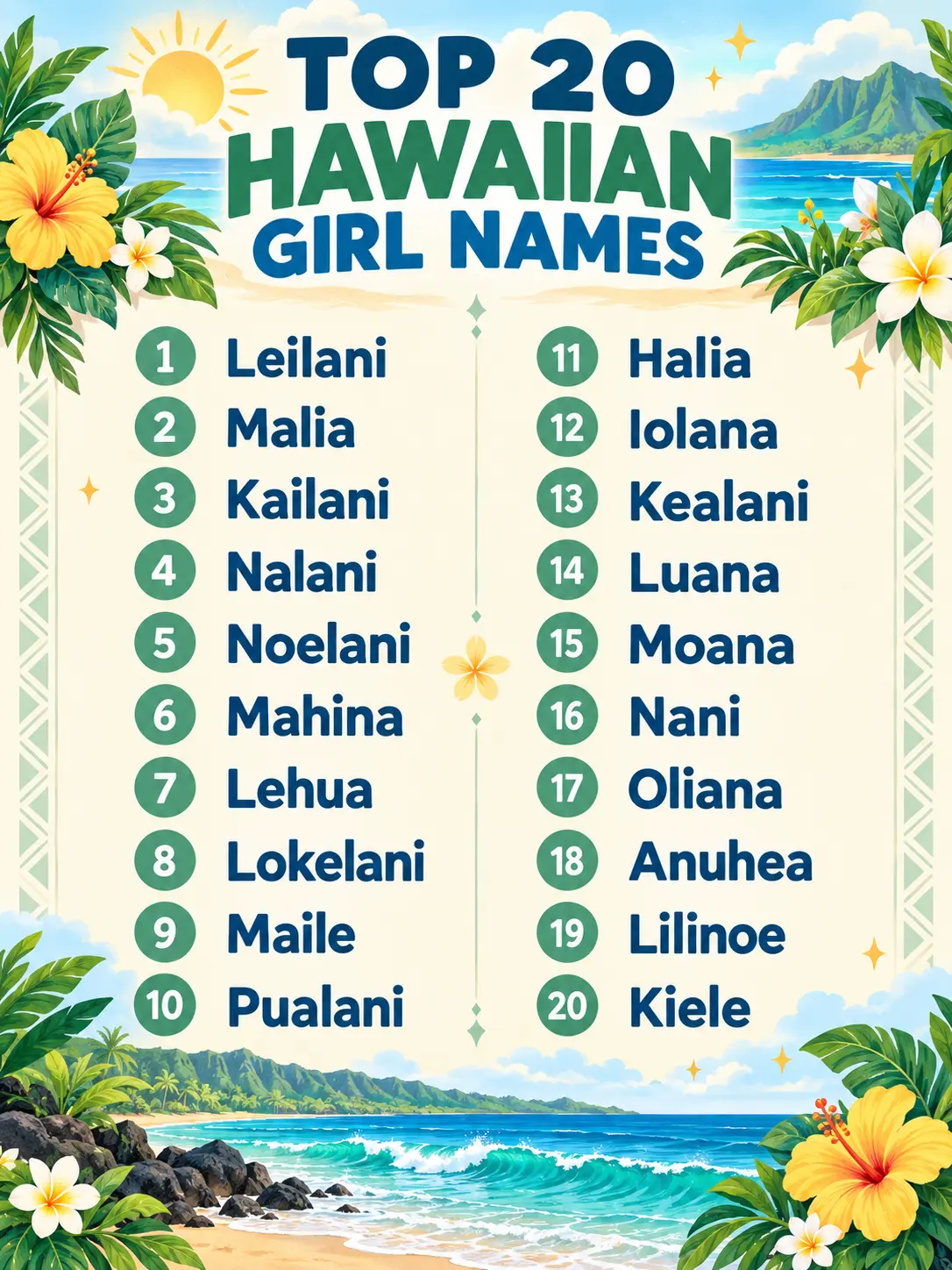
Hawaiian Flower and Nature Names
Flowers in Hawaiian naming are more than decorative images. A pua can refer to a flower, blossom, or child, while a lei may represent a garland, affection, or a beloved child. Some names below are plant words that have also become personal names.
| Name | Pronunciation | Meaning or background |
|---|---|---|
| ʻIlima | ee-LEE-mah | The ʻilima flower, associated with Oʻahu |
| Kapua | kah-POO-ah | The flower or blossom; can also relate to a cloud |
| Kiele | kee-EH-leh | Gardenia |
| Lauaʻe | low-AH-eh | A fragrant native fern |
| Lehua | leh-HOO-ah | Blossom of the ʻōhiʻa lehua tree |
| Leimomi | lay-MOH-mee | Lei of pearls or pearl lei |
| Loke | LOH-keh | Hawaiian form of rose |
| Maile | MY-leh | A fragrant native vine traditionally woven into lei |
| Melia | meh-LEE-ah | Plumeria |
| Momi | MOH-mee | Pearl |
| Nāpua | NAH-poo-ah | The flowers or the children |
| Pīkake | pee-KAH-keh | Jasmine |
| Pua | POO-ah | Flower, blossom, or child |
| Puakea | poo-ah-KEH-ah | White flower |
| Puanani | poo-ah-NAH-nee | Beautiful flower |
Maile works especially well for families who like botanical names without an obvious English flower reference. Puanani feels more elaborate, while Pua is compact and bright.
Names Inspired by the Ocean, Sky, Moon, and Light
Hawaiian vocabulary offers vivid names connected to the islands’ natural environment. These choices range from short words such as Kai and Nalu to longer compounds that hold an entire image.
| Name | Pronunciation | Meaning or background |
|---|---|---|
| Alaula | ah-lah-OO-lah | Light of dawn or glow of sunset |
| Aolani | au-oh-LAH-nee | Heavenly cloud or cloud of heaven |
| Hōkū | HOH-koo | Star |
| Hōkūlani | hoh-koo-LAH-nee | Heavenly star |
| Kai | KYE | Sea or ocean |
| Kaimana | kye-MAH-nah | Power of the sea |
| Kawena | kah-WEH-nah | Rosy glow or radiance |
| Kehaulani | keh-how-LAH-nee | Heavenly dew |
| Mahina | mah-HEE-nah | Moon or moonlight |
| Māhealani | mah-heh-ah-LAH-nee | The night of the full moon |
| Makani | mah-KAH-nee | Wind |
| Naiʻa | nye-AH | Dolphin |
| Nalu | NAH-loo | Wave or surf |
| Ualani | oo-ah-LAH-nee | Heavenly rain |
| Waiola | why-OH-lah | Water of life |
Kai, Moana, Nalu, and Kaimana all relate to the ocean, but they create very different impressions. Kai is direct and widely used across genders. Moana is lyrical and familiar, while Kaimana feels longer and more energetic.
Names Connected to Love, Joy, and Beauty
Some of the most expressive Hawaiian baby girl names are built from words for affection, happiness, beauty, peace, and preciousness. These meanings are appealing, but the complete name matters; two familiar elements do not always produce the meaning an English speaker might assume.
| Name | Pronunciation | Meaning or background |
|---|---|---|
| Kalei | kah-LAY | The lei or beloved child |
| Kanani | kah-NAH-nee | The beauty or splendor |
| Kamea | kah-MEH-ah | The one and only; precious one |
| Kuʻulei | koo-oo-LAY | My lei or my beloved |
| Kuʻuipo | koo-oo-EE-poh | My sweetheart or beloved |
| Lauleʻa | lau-LEH-ah | Happiness, peace, or friendship |
| Lei | LAY | Garland, lei, or beloved child |
| Leialoha | lay-ah-LOH-hah | Lei of love or beloved child |
| Leinani | lay-NAH-nee | Beautiful lei |
| Makana | mah-KAH-nah | Gift |
| Malu | MAH-loo | Shelter, shade, peace, or protection |
| Nohea | noh-HEH-ah | Lovely or handsome |
| ʻOlina | oh-LEE-nah | Joyful or joyous |
| Uʻi | OO-ee | Beauty, youthfulness, or beautiful |
| Uʻilani | oo-ee-LAH-nee | Heavenly beauty |
Leialoha, Leinani, and Leilani share the lei sound but do not have identical meanings. This is a good example of why it is worth checking the full construction rather than choosing a name based only on one familiar syllable. You can also explore girl names beginning with L if you like their flowing sound.
Rare and Traditional Hawaiian Choices
The following names may be less familiar outside Hawaiʻi. Some describe mist, rain, fragrance, calmness, or family affection. The final two are Hawaiian-language forms of Western names that have a documented history of use in Hawaiʻi rather than recently invented spellings.
| Name | Pronunciation | Meaning or background |
|---|---|---|
| Anuhea | ah-noo-HEH-ah | Cool, soft fragrance |
| Hāliʻa | hah-LEE-ah | Fond remembrance or cherished memory |
| Haunani | how-NAH-nee | Beautiful snow or beautiful dew |
| Hiʻilani | hee-ee-LAH-nee | Held or embraced by heaven |
| Kaʻiulani | kah-ee-oo-LAH-nee | The royal sacred one; associated with Hawaiian royalty |
| Kamalani | kah-mah-LAH-nee | Heavenly or royal child |
| Kanoe | kah-NOH-eh | The mist |
| Kanoelani | kah-noh-eh-LAH-nee | Heavenly mist |
| Kēhau | KEH-how | Dew |
| Kilinahe | kee-lee-NAH-heh | Fine, gentle rain |
| Lilinoe | lee-lee-NOH-eh | Fine mist |
| Lōkahi | loh-KAH-hee | Unity, harmony, or agreement |
| Mālie | MAH-lee-eh | Calm, quiet, or serene |
| Lahela | lah-HEH-lah | Hawaiian form of Rachel |
| ʻEmele | EH-meh-leh | Hawaiian form of Emily |
Kaʻiulani is beautiful, but it carries a direct association with Princess Victoria Kaʻiulani. Families without that cultural or ancestral connection may prefer a nature-based name and reserve royal or chiefly names for those who understand their history more personally.
How to Pronounce Hawaiian Girl Names?
Hawaiian pronunciation is more regular than English pronunciation. These basic patterns will help with most names on this page:
- A sounds like ah, e like eh, i like ee, o like oh, and u like oo.
- Pronounce every vowel. In Puanani, for example, the opening pua is spoken across two vowel sounds.
- An ʻokina creates a short pause. Kuʻulei is not pronounced exactly like “cool-ay”; the pause separates kuʻu from lei.
- A kahakō lengthens the vowel. Hōkū therefore sounds different from an unmarked “hoku.”
- Our capital letters show approximate emphasis for an English speaker, but they cannot capture every feature of a fluent Hawaiian pronunciation.
If a name will be used daily, listen to a trusted Hawaiian-language pronunciation and ask a knowledgeable speaker when possible. Correct pronunciation is part of preserving the name’s meaning.
Authentic Hawaiian Names and Hawaiian-Inspired Names Are Not the Same
Modern baby-name lists often label any name containing kai, lei, or lani as Hawaiian. Some are genuine Hawaiian words or documented names. Others are recent combinations, altered spellings, or names from entirely different languages that happen to sound similar.
That does not make a modern name unusable, but it does change how it should be described. Kailani, for example, is a transparent modern compound of Hawaiian words for sea and sky. By contrast, spellings created by adding letters to imitate Leilani should not automatically be presented as traditional Hawaiian names with the same established meaning.
Before choosing a name:
- Look it up with its diacritical marks.
- Check whether it is a Hawaiian word, a documented personal name, a translated Western name, or a modern construction.
- Confirm the meaning of the complete name rather than combining dictionary definitions yourself.
- Practice the Hawaiian pronunciation, not only the anglicized one.
- Consider whether the name belongs to a specific royal figure, deity, place, or family history.
Choosing the Name That Fits Your Family
Begin with meaning, then test the name in ordinary life. Say the first, middle, and last names together. Write the initials. Think about whether you are comfortable correcting pronunciation and preserving the ʻokina or kahakō on forms that support them.
You may also notice a preferred rhythm. Short choices such as Lei, Kai, Pua, and Nani pair easily with longer surnames. Leialoha, Māhealani, and Kanoelani create a more flowing full name and may suit a short middle name. Families considering Malia, Maile, Mahina, or Moana can browse more baby girl names that start with M before making a shortlist.
A Hawaiian name is more than an island-themed sound. The strongest choice is one whose spelling, pronunciation, meaning, and cultural context you are prepared to carry with care. When one name keeps returning to your list after those checks, it is usually worth a closer look.
