




Figuring out how many naps a baby needs by age can feel like trying to solve a puzzle where the pieces keep changing shape. Babies grow rapidly, and their sleep needs evolve just as fast.
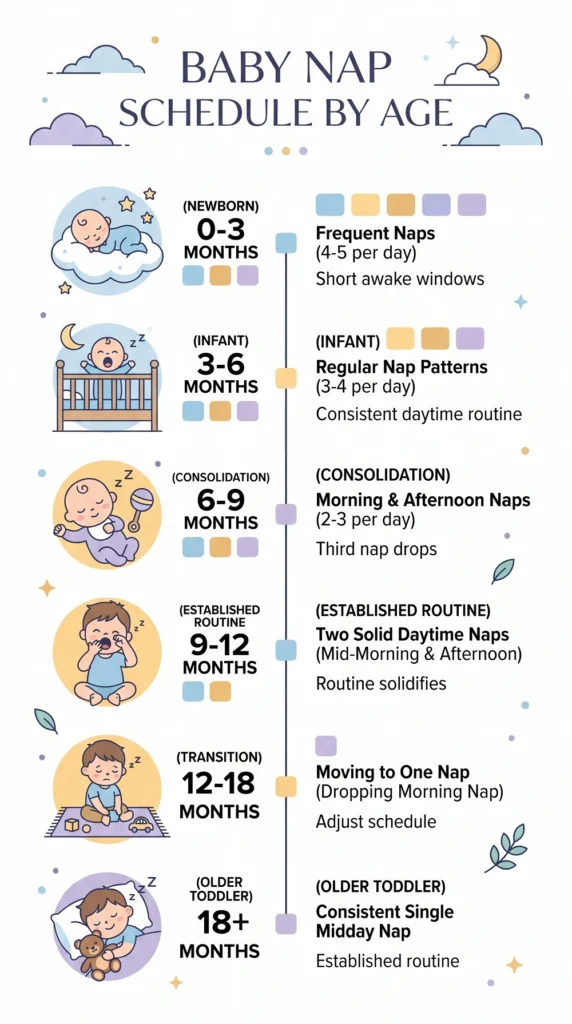
Generally, a newborn will take anywhere from 4 to 6 short naps a day, as they sleep around the clock. By 3 to 4 months, most babies settle into a pattern of 3 to 4 naps. Between 6 and 9 months, they typically transition to 2 or 3 naps. By their first birthday, most are taking 2 solid naps, and between 13 and 18 months, toddlers usually drop down to a single afternoon rest.
If your baby’s current routine looks completely different than the textbook schedule, take a deep breath. These numbers are averages, and healthy babies will often find a rhythm that works specifically for them.
At a Glance: Baby Napping Basics
- Newborns sleep around the clock: Day and night are often mixed up in the first few weeks, resulting in frequent, irregular naps.
- Watch the clock: As babies grow, they can comfortably stay awake for longer stretches, naturally reducing their daily nap count.
- Transitions take time: Dropping a nap usually happens over a few weeks, with some days requiring an extra “catnap” to bridge the gap to bedtime.
- Safety first: Always place your baby on their back on a firm, flat surface for every nap, strictly following current safe sleep guidelines.
Month-by-Month Guide to Baby Naps
Please note: The following information is for general educational purposes. Every child develops at their own pace. If you have concerns about your infant’s sleep, growth, or overall health, consult your pediatrician for an individualized medical evaluation.
To help you understand what to expect, here is a breakdown of typical daytime sleep patterns during your child’s first year and beyond.
Newborns (0 to 2 Months)
Typical number of naps: 4 to 6 (or continuous sleep cycles)
During the first few weeks of life, babies do not have a set circadian rhythm—the internal clock that tells us to be awake during the day and sleep at night. A newborn’s stomach is tiny, meaning they need to wake frequently to eat. You can expect your newborn to sleep for 14 to 17 hours in a 24-hour period, waking every 2 to 3 hours around the clock.
Naps at this age are highly unpredictable. One nap might last 20 minutes, while the next stretches to two hours. Instead of looking for a rigid schedule, focus on keeping your baby well-fed and helping them learn the difference between day and night. Keep the house bright and reasonably noisy during the day, and dim and quiet at night.
Infants (3 to 5 Months)
Typical number of naps: 3 to 4
Around 3 to 4 months, your baby’s body begins producing melatonin, and their sleep patterns start looking a bit more organized. They will typically stay awake for 1.5 to 2 hours between sleep periods.
Many babies in this age bracket take a morning nap, an early afternoon nap, a late afternoon nap, and sometimes a quick evening catnap. You might also encounter the dreaded “4-month sleep regression” during this window. This happens because your baby is transitioning from newborn sleep cycles to more adult-like sleep cycles, which can temporarily cause them to fight naps or wake up more frequently. Consistency is your best tool for getting through this phase.
Older Infants (6 to 8 Months)
Typical number of naps: 2 to 3
By 6 months, most babies are fully capable of sleeping longer stretches at night and consolidating their daytime sleep into more predictable blocks. Wake windows usually extend to 2 to 2.5 hours.
Your baby will likely take a solid morning nap and a solid afternoon nap. If those first two naps are short, they may still need a brief third nap late in the day just to make it to bedtime without becoming overtired. If they do take a third nap, keep it brief—usually 30 to 45 minutes—so it does not interfere with nighttime sleep.

Pre-Toddlers (9 to 12 Months)
Typical number of naps: 2
At this stage, daytime sleep usually settles into a highly reliable two-nap routine. Your baby can likely stay comfortably awake for 3 to 4 hours at a time. A typical schedule often includes a morning nap starting around 9:30 or 10:00 a.m., and an afternoon nap starting around 2:00 p.m.
Total daytime sleep usually hovers around 2 to 3 hours. Some 10- or 11-month-olds will suddenly protest their morning or afternoon nap, leading parents to believe it is time to drop to one nap. Pediatricians generally recommend holding onto two naps until at least 12 months, as this early resistance is often a temporary phase linked to developmental milestones like pulling up or walking.
Toddlers (13 to 18 Months)
Typical number of naps: 1 to 2
Sometime shortly after their first birthday, your toddler will transition to one single afternoon nap. This nap usually takes place right after lunch and can last anywhere from 1.5 to 3 hours.
The transition to one nap can be tricky. You might find that your toddler is completely exhausted by 11:00 a.m. but refusing to sleep by 3:00 p.m. Pushing the morning nap later by 15 minutes every few days is a gentle way to eventually bridge the gap to a single midday rest.
Quick Reference: Average Baby Sleep Needs by Age
While schedules vary, having a baseline can help you gauge whether your baby is getting enough rest.
| Age | Number of Naps | Total Daytime Sleep | Typical Wake Window |
| 0–2 months | 4–6 | 4–8 hours | 45–90 minutes |
| 3–5 months | 3–4 | 3–5 hours | 1.5–2 hours |
| 6–8 months | 2–3 | 2.5–4 hours | 2–2.5 hours |
| 9–12 months | 2 | 2–3 hours | 3–4 hours |
| 13–18 months | 1–2 | 1.5–3 hours | 4–5.5 hours |
To find an estimate tailored specifically to your child’s age and current routine, you can use this baby sleep calculator. Just remember that calculators provide general estimates based on averages and are meant to be a helpful starting point, not a medical directive.
Understanding Wake Windows and Sleep Cues
A “wake window” is simply the amount of time your baby can happily stay awake between sleep periods. If you keep a baby awake past their ideal window, their body releases cortisol and adrenaline to fight off fatigue. This makes them overtired, which ironically makes it much harder for them to fall asleep and stay asleep.
Instead of only watching the clock, watch your baby for physical signs of tiredness.
Early sleep cues (time to start the nap routine):
- Staring blankly into space or losing interest in toys
- Redness around the eyebrows or eyes
- Slower, less coordinated movements
- Turning their head away from stimulation
Late sleep cues (your baby is becoming overtired):
- Yawning and rubbing eyes aggressively
- Fussiness or irritability
- Crying and arching the back
Catching your baby during those early cues will make putting them down for a nap significantly easier.
Navigating Common Nap Transitions
Dropping a nap is rarely a one-day event. It is usually a messy process that takes two to four weeks to fully smooth out.
How do you know when your baby is actually ready to drop a nap? Look for these three signs lasting for more than a week:
- They consistently take 30 to 45 minutes to fall asleep for a nap they previously went down for easily.
- They flat-out refuse the final nap of the day.
- They start waking up unusually early in the morning (e.g., 4:30 a.m.), which can signal they are getting too much daytime sleep.
When you decide to drop a nap, you will likely need to adjust their bedtime. If an 8-month-old drops their third late-afternoon nap, their afternoon wake window might suddenly be uncomfortably long. Moving their bedtime up by 30 to 45 minutes temporarily can prevent them from becoming overtired until they adjust to the new schedule.
What to Do When Your Baby Fights Naps
Nap strikes happen to almost every family. Teething, growth spurts, traveling, illness, or learning a new skill (like crawling) can all disrupt a previously perfect napper.
If your baby is fighting sleep:
- Evaluate their environment: Is the room dark enough? Is it too warm? The American Academy of Pediatrics (AAP) suggests keeping a baby’s room at a comfortable temperature—usually around 68°F to 72°F. A white noise machine can also help drown out household sounds.
- Check their wake window: They might not be tired enough, or they might be overtired. Try shifting naptime forward or backward by 15 minutes.
- Implement a mini-routine: Babies thrive on predictability. You don’t need a 30-minute routine for naps like you might for bedtime. A simple 5-minute wind-down—closing the blinds, reading one short book, and putting on a sleep sack—cues their brain that it is time to rest.
Safe Sleep Reminders for Napping
Whether it is a 20-minute morning snooze or a 2-hour afternoon stretch, naptime safety rules are exactly the same as nighttime safety rules. The AAP recommends the following to reduce the risk of Sudden Infant Death Syndrome (SIDS) and sleep-related injuries:
- Back to sleep: Always place your baby on their back for every sleep.
- Firm, flat surface: Use a crib, bassinet, or play yard with a firm, flat mattress and a fitted sheet.
- Keep it bare: Do not put blankets, pillows, bumper pads, or stuffed toys in the sleep space.
- Avoid inclined sleepers: Babies should not routinely sleep in car seats, swings, or inclined loungers. If your baby falls asleep in a car seat or swing, move them to a firm sleep surface as soon as it is safe and practical to do so.
When to Talk to Your Pediatrician About Sleep
Sleep variations are normal, but some issues warrant a conversation with a healthcare professional. Reach out to your pediatrician if you notice any of the following:
- Your baby regularly snores loudly, gasps, or seems to pause breathing during naps.
- Your baby seems completely inconsolable during the day and is getting significantly less sleep than the averages for their age.
- Your baby is extremely difficult to wake up from naps or seems unusually lethargic during their wake windows.
- You feel overwhelmed, deeply anxious, or depressed about your baby’s sleep patterns. Your doctor is there to support both your baby’s health and your well-being.
Frequently Asked Questions
Should I wake a sleeping baby from a nap?
Usually, it is best to let a baby sleep. However, there are two main exceptions. First, newborns who have not yet reached their birth weight should be woken to feed every 2 to 3 hours based on your doctor’s advice. Second, if an older infant takes a nap that stretches past 2.5 or 3 hours, or sleeps too late into the evening, gently waking them can help preserve their nighttime sleep schedule.
What is a contact nap?
A contact nap is when a baby sleeps while being held by or resting directly on a parent or caregiver. While contact naps are incredibly common and biologically normal for young infants, the caregiver must remain awake and alert the entire time to ensure the baby’s airway stays open and safe.
Why are my baby’s naps only 30 minutes long?
Short naps are very common in babies under 6 months. It takes time for their brains to learn how to connect sleep cycles. A typical baby sleep cycle lasts about 30 to 45 minutes. If they wake up at the end of that cycle and haven’t learned to soothe themselves back to sleep, the nap ends. This usually improves naturally as they get closer to 6 or 7 months.
Can formula or breastmilk intake affect nap length?
Hunger is a primary reason babies wake up. Ensuring your baby gets full, satisfying feedings during their wake windows can help them sleep longer stretches. However, adding cereal to a bottle will not help a baby sleep better and is a choking hazard, according to the AAP.
Do premature babies need more naps?
Yes, babies born prematurely usually require more sleep than full-term babies of the same chronological age. When looking at sleep charts and awake windows, you should generally use your baby’s adjusted age (their age based on their original due date) rather than their actual birth date during their first year or two.
Determining how many naps a baby needs by age is a moving target, but tracking their patterns can bring a sense of order to your days. Taking a few moments to log their sleep times can help you spot emerging patterns before a nap transition sneaks up on you. If you need a little help visualizing the right schedule for your current stage, checking our Baby Sleep Calculator can give you a solid, age-appropriate starting point.
