




Most children transition from a crib to a toddler bed sometime between 18 months and 3 years, but age alone should not decide it. Move sooner if your child can climb out, is about 35 inches tall, or has reached the crib manufacturer’s height or weight limit. If the crib is still safe and your child sleeps comfortably, there is usually no reason to rush the change simply because they have turned two.
Key takeaways
- Climbing out or outgrowing the crib makes the move a safety decision, not a readiness test.
- A child who is safe and content in the crib can usually stay there until a genuine reason to change appears.
- Toddler beds are generally intended for children at least 15 months old; always follow the limits for the specific bed and mattress.
- Once the crib rails are gone, the entire bedroom and the route your child can access must be childproofed.
- Keep bedtime familiar and respond to getting out of bed calmly and consistently.
The clearest sign: the crib is no longer containing your child safely
A toddler does not need to express excitement about a “big-kid bed” before leaving the crib. If they can swing a leg over the rail, pull themselves onto the top, or climb out, the fall risk matters more than emotional readiness.
Start by confirming that the crib mattress is already at its lowest approved position and that nothing inside or beside the crib can be used as a step. Large toys, pillows, storage boxes, and nearby furniture can give an active child the extra height needed to get over the rail. Do not modify the crib, add a tent, or use a product that the manufacturer has not approved for it.
Also check the crib manual and product label. The child’s height, weight, or developmental abilities may place them beyond the manufacturer’s limits even if you have not witnessed an escape. CPSC crib guidance uses 35 inches as a height marker for moving a child to a youth or regular bed.
If your child has climbed out once, treat that as evidence that they can do it again. Use a safe temporary sleep arrangement while you prepare the new bed and room rather than waiting for another attempt.
Age is useful context, but not a deadline
The transition from crib to toddler bed often happens between 18 months and 3 years. That broad range reflects real differences in height, climbing ability, sleep habits, and crib design. A physically adventurous 20-month-old may need to move before a cautious child who remains comfortable in the crib well after age two.
A toddler bed is a small, low bed designed to use a full-size crib mattress. Under the federal toddler-bed standard, it is intended for a child who is at least 15 months old and weighs no more than 50 pounds. The standard includes requirements meant to reduce entrapment and other hazards, but parents still need to follow the instructions and limits for the particular product.
If your child is younger than the minimum age for the bed you own, speak with your pediatrician about an appropriate sleep space rather than improvising with an adult bed or unapproved equipment.
A quick decision guide
| What you are seeing | What it usually means |
|---|---|
| Your child climbs or attempts to climb over the crib rail | Begin the transition promptly and make the room safe |
| Your child has reached the crib’s stated limit | Stop using the crib and follow its instructions |
| The rail reaches around chest level when your child stands | Recheck the child’s height and crib limits; climbing risk may be increasing |
| Your child asks for a bed but the crib remains safe | Consider the change, but there is no safety need to rush |
| Bedtime resistance is the only concern | Address the routine first; a new bed may create more opportunities to leave |
| A new baby will need the crib | Plan early if your toddler is ready, or arrange another safe infant sleep space |
Readiness signs that can make the change easier
Safety can force the timing, but when you have flexibility, a few developmental signs suggest that your child may understand the new expectations.
They may be able to follow simple directions such as “lie down” or “stay in bed,” show interest in sleeping in a bed, and cope reasonably well with small changes in routine. Some children can also get in and out of a low bed steadily without treating it as climbing equipment.
Do not confuse ordinary sleep disruption with readiness. Teething, illness, separation anxiety, travel, a changing nap, or a late bedtime can all cause resistance while the crib itself remains appropriate. Moving to a bed rarely solves those underlying issues and sometimes makes them more visible because the child can now get up.
Choose a sleep setup that fits your child and your space
There is no requirement to buy a dedicated toddler bed. Families commonly choose among three arrangements, each with practical tradeoffs.
A convertible crib
Removing the approved side or installing the manufacturer’s toddler-bed conversion kit keeps the same mattress and familiar frame. Use only the components intended for that exact crib model. A missing rail is not the same as a properly converted crib.
A toddler bed
A toddler bed sits low to the floor and uses the crib mattress, which can make the change feel smaller. Confirm that the frame, guardrails, support system, and mattress fit meet current safety requirements. Register a new bed with the manufacturer and check for recalls, particularly if it is secondhand.
A low twin bed
Some families skip the toddler bed and move to a low twin bed. This may last longer, but a standard bed and any portable rail need to be appropriate for the child’s age and installed exactly as directed. Gaps between a mattress, wall, frame, or rail can create entrapment hazards. Avoid assuming that pushing a mattress or bed tightly against a wall makes it safer.
Whichever option you use, keep the sleep surface low and the floor around it clear. Follow the mattress and frame instructions rather than adding homemade barriers, rolled towels, or loose padding.
Before the first night, make the whole room safe
In a crib, the sleep space has clear boundaries. In a bed, a toddler may quietly explore while adults are asleep. Think of the bedroom as the new sleep enclosure and check it from your child’s height.
- Anchor dressers, bookcases, and other climbable furniture to the wall.
- Use cordless window coverings and position the bed away from windows and cords.
- Secure windows with appropriate guards or opening limits; a screen does not prevent a fall.
- Cover unused outlets and manage lamp, monitor, and charging cords so they cannot be pulled or wrapped around the body.
- Lock away medicines, cosmetics, batteries, small objects, and other choking or poisoning hazards.
- Remove heavy decor, large toys, and unstable furniture near the bed.
- Use a hardware-mounted gate at the top of stairs, not a pressure-mounted or pet gate.
- Make sure smoke and carbon monoxide alarms are installed and working.
The CPSC notes that determined toddlers can defeat some child-safety devices, so correct installation and continued supervision still matter. Its home-childproofing guidance specifically recommends furniture anchors, cordless window coverings, appropriate window guards, and safety gates that meet current standards.
Decide how you will safely limit nighttime wandering without preventing an adult from reaching the child quickly in an emergency. The right setup depends on the room, stairs, exits, and other hazards in the home. Never lock a child in a way that interferes with emergency access or fire safety.
How to transition from a crib to a toddler bed?
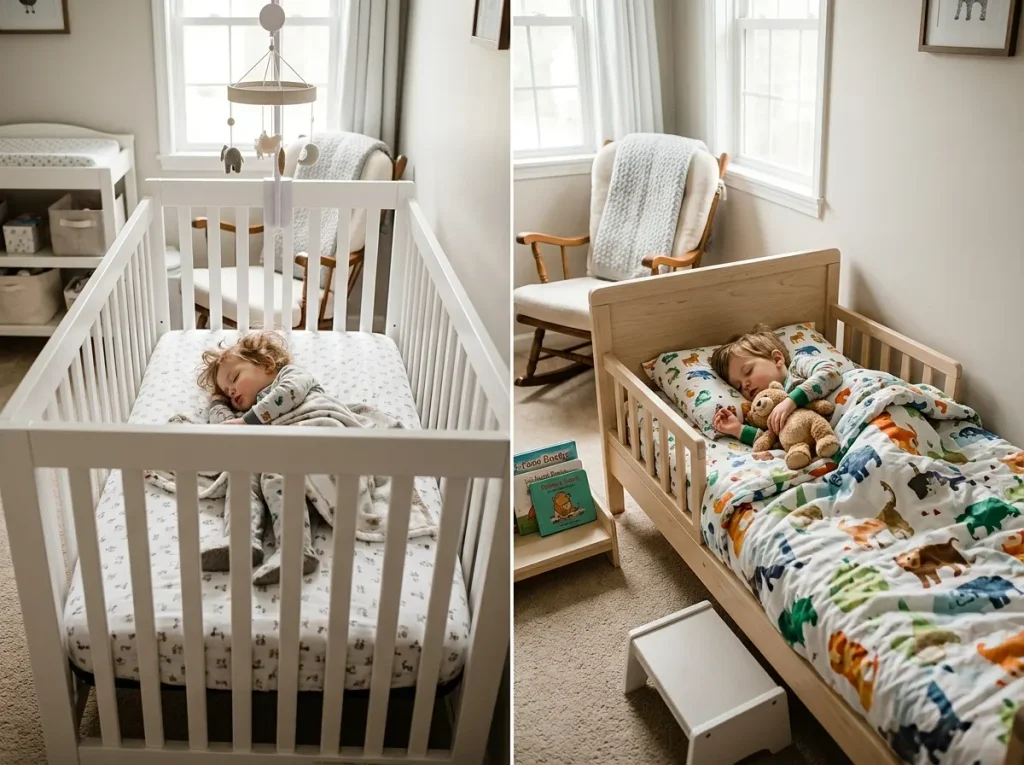
The bed is new, but bedtime does not need to become a major production. Familiarity usually helps more than an elaborate celebration.
Explain the change in simple language
Tell your child what will happen shortly before the move: “You will sleep in this bed. We will do bath, book, cuddle, and goodnight just like we always do.” Keep the message positive without promising that they will love it or describing the crib as being for babies.
If you have some flexibility, let your child choose between two fitted sheets or decide which familiar bedtime book comes first. Small choices provide involvement while the adult keeps control of the sleep arrangement.
Preserve the usual bedtime sequence
Keep the same bedtime, lighting, comfort item, song, and goodnight phrase when possible. A predictable order tells a toddler what comes next even when the furniture has changed.
If the routine has become long or inconsistent, simplify it before the move. A brief pattern such as pajamas, teeth, two books, cuddle, and lights out is easier to repeat than a chain of requests that changes each night.
State one clear boundary
Use a short rule your child can understand: “At bedtime, your body stays in bed.” Show them where to find you if they genuinely need help and what will happen in the morning.
Toddlers often test a new freedom by getting up repeatedly. Calmly guide your child back with very little conversation. Long explanations, negotiations, snacks, extra stories, or playful attention can turn leaving the bed into the most interesting part of the evening. The American Academy of Pediatrics recommends keeping these returns quiet and low-key while praising the child for staying in bed.
Morning praise can be specific: “You stayed in your bed until your wake-up light turned green,” or “You called for me instead of going into the hallway.” That gives the child a behavior they can repeat.
If a new baby is the reason for the move
Needing the crib for a sibling is a practical concern, but it does not automatically mean the older child is ready to leave it. A newborn can initially use another approved infant sleep space, so check all safe options before rushing the toddler.
If your older child is ready, make the transition well before the baby’s arrival when possible. This gives the bed time to become truly theirs instead of feeling like a hurried eviction from the crib. Avoid repeatedly saying that the baby “needs your crib.” Focus on the older child’s new space and keep the crib out of the emotional negotiation.
Try not to combine the bed transition with several other major changes, such as starting child care, giving up a pacifier, moving homes, or intensive toilet training. Real life will not always allow perfect spacing, but a quieter week can make consistent responses easier for everyone.
What to do if sleep becomes harder
More bedtime exits and earlier morning wandering are common after the move because the physical boundary has disappeared. First, check whether the schedule still fits. A nap that ends late, an inconsistent wake time, or a bedtime that is too early may leave a toddler awake in a room they can explore.
Then look at your response. If one exit earns an extra book, another earns a snack, and the fifth leads to sleeping in the parent’s bed, the child cannot easily predict the boundary. Choose a calm response the household can repeat.
If you moved for preference rather than safety and your child is clearly overwhelmed, a temporary return to a safe crib may be reasonable. Do not return to the crib if the child can climb out or has exceeded its limits. In that case, keep the safer bed setup and work on the routine and room boundaries instead.
Avoid threatening to take away the bed, shaming your child for being “a baby,” or physically restraining them in bed. The goal is to make the boundary boring, predictable, and safe—not frightening.
Making the Move With Confidence
Moving from a crib to a toddler bed does not need to happen on a particular birthday. The right moment comes when the crib is no longer safe or when the change genuinely fits your child’s development and your family’s needs. If the crib remains appropriate and your child sleeps comfortably, waiting is a reasonable choice.
When the time arrives, prepare the room before introducing the bed, preserve the familiar parts of bedtime, and expect your toddler to test their new freedom. A calm, repeatable response matters more than creating a flawless first night. With a safe setup and consistent boundaries, the new bed will gradually become an ordinary part of the routine rather than a nightly event.
