




A toddler bedtime routine is a short, predictable series of calming steps that starts 30 to 60 minutes before sleep. When you do the same steps in the same order every night, the routine becomes a cue that tells your child’s brain and body it’s time to shift from play to rest. The routines that work best aren’t elaborate. They’re consistent, and simple enough that any caregiver can run them the same way.
Place this between the second intro paragraph and “Wind Down Before the Routine Starts”:
Key Takeaways
- Start the routine 30 to 60 minutes before sleep, and do the same steps in the same order every night.
- Turn off screens at least an hour before bedtime, and fill that time with quiet play in dim light.
- The 4 B’s (bath, brush, books, bed) give you a simple structure that usually takes 30 to 45 minutes.
- Build common stalling requests, like a drink of water, into the routine, and keep any trips back to bed calm and boring.
- A cool, dark room with a low-volume sound machine (about 50 decibels or less at the bed) makes the routine easier to stick with.
- Talk to your pediatrician about loud snoring, pauses in breathing, or sleep problems that don’t improve with a consistent routine.
If bedtime at your house tends to stretch on with “one more book” and “one more drink,” a clear step-by-step plan gives everyone the same script. Over a few weeks, that predictability usually means less stalling and an easier time settling down.
Wind Down Before the Routine Starts
The routine itself works better when the whole evening slows down first. Toddlers pick up on their surroundings, and a loud, bright, busy house can make it hard for them to notice they’re tired.
The American Academy of Pediatrics (AAP) recommends turning off all screens at least one hour before bedtime. Screen light can delay the release of melatonin, the hormone that helps regulate the sleep-wake cycle, and fast-paced shows or games can leave a toddler more wound up than sleepy.
Once screens are off, fill the time with quiet play. Dim the overhead lights and bring out low-energy activities like building with blocks or doing a simple puzzle together.
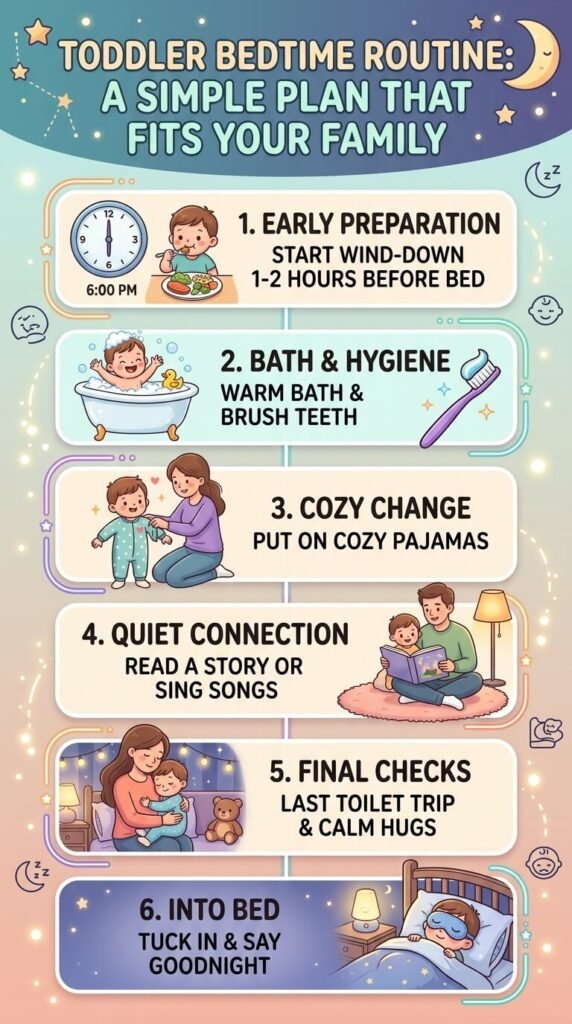
A Simple 4-Step Framework: The 4 B’s
You don’t need a complicated schedule to get a toddler to sleep. The AAP suggests a simple “brush, book, bed” routine for young children, and many families add a bath at the start to make it the 4 B’s. From start to finish, it usually takes 30 to 45 minutes.
If different caregivers handle bedtime on different nights, tape a short list of the steps to the bathroom mirror so everyone follows the same order.
1. Bath (or Wash)
A warm bath draws a clear line between the busy day and the quiet night. Warming up in the tub and cooling down afterward may also help the body feel ready for sleep. If a nightly bath dries out your toddler’s skin, or you’re short on time, washing their face and hands with a warm washcloth works just as well as a signal that bedtime has started.
2. Brush
Brushing is the one step to keep even on rushed nights. Brush your toddler’s teeth for about two minutes with fluoride toothpaste: a smear the size of a grain of rice for children under 3, and a pea-sized amount from age 3 to 6. Your child doesn’t need to rinse with water afterward. Spitting out the extra is enough once they can do it. Then change into pajamas and a fresh overnight diaper or training pants.
3. Books
Reading together is one of the calmest ways to wind down, and it supports early language skills at the same time. Set the limit before you start: “We’re reading two books tonight.” Letting your toddler pick those two books gives them a sense of control, which tends to cut down on protests. If you want something new without buying more books, try our bedtime story generator to create a short, calming story. Read in a dim room in a low, quiet voice.
4. Bed
The last step is getting into bed for lights-out. Keep the goodnight short and the same every night, whether that’s a snuggle and one song or a phrase like “I love you. Time to sleep.” Turn on the sound machine if you use one, switch off the light, and leave while your toddler is drowsy but still awake. If your family’s routine is to stay until your child falls asleep, keep that time just as quiet and predictable.
Managing Bedtime Stalling
Toddlers test limits, and bedtime gives them plenty of chances. “One more drink of water,” “I need another hug,” and sudden trips to the potty are normal at this age.
The simplest fix is to build their usual requests into the routine. If your child always asks for water, offer a small sip right before brushing teeth. If there’s a stuffed animal they suddenly can’t sleep without, make finding it part of putting on pajamas.
For protests after lights-out, try the “boring return.” If your toddler gets out of bed, walk them back right away with little eye contact and very little talking. Use the same calm, firm phrase each time, such as “It’s bedtime. Stay in your bed.” You may need to do this a dozen times the first few nights. Getting upset or negotiating gives your child attention for leaving the bed, which tends to keep the behavior going.
Setting Up the Bedroom for Sleep
A good routine is easier to stick with when the bedroom supports sleep too.
Keep the room cool but comfortable, roughly 68 to 72°F, and dress your toddler in pajamas that suit the temperature.
Blackout curtains block streetlights and early morning sun. If your toddler starts to feel scared of the dark, a small, dim nightlight with a warm amber or red glow is less stimulating than bright white or blue light.
A white noise machine can cover household sounds like older siblings playing or a TV in the next room. Place it across the room, away from your child’s bed, and keep the volume low. Many sound machines get surprisingly loud at close range, so aim for about 50 decibels or less at the bed, roughly the hum of a quiet refrigerator. A free decibel app on your phone can help you check.
When to Talk to Your Pediatrician
If your toddler still struggles with sleep after a few weeks of a consistent routine, or if they snore loudly or seem to pause in their breathing while asleep, mention it to your pediatrician. These can be signs of a sleep problem worth checking. This article is general information and isn’t a substitute for advice from your child’s doctor.
