



If you are trying to conceive or simply want to understand your body better, you have likely seen the terms “fertile window” and “ovulation day” used interchangeably. However, they describe two very distinct parts of your menstrual cycle.
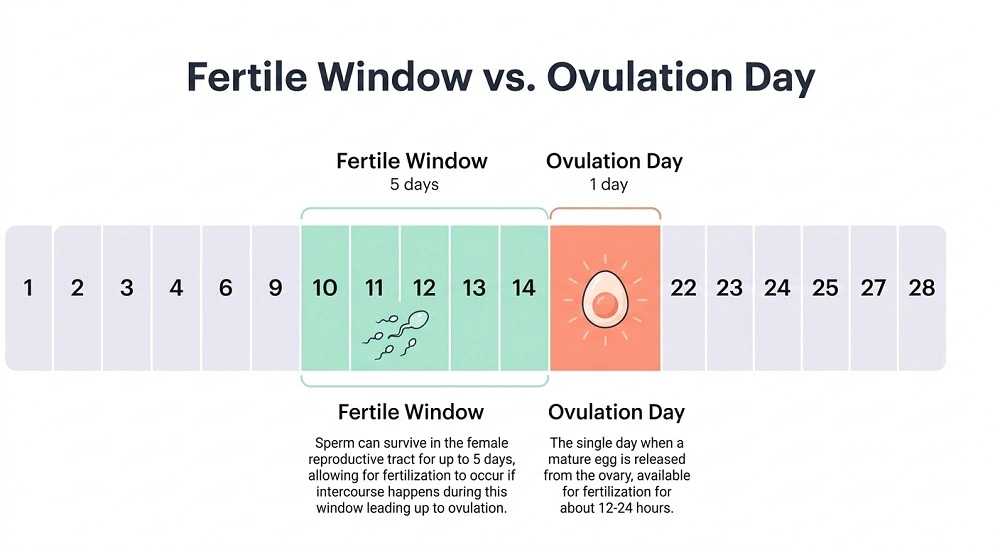
The main difference between the two comes down to timing and biology. Ovulation day is the single event when one of your ovaries releases a mature egg. This egg only survives for 12 to 24 hours. Your fertile window, on the other hand, is the broader five-to-six-day timeframe leading up to and including ovulation. Because healthy sperm can survive inside the female reproductive tract for up to five days, having intercourse during the days before ovulation actually provides the highest chance of getting pregnant.
Understanding how these timelines overlap takes the guesswork out of family planning and helps you tune into the natural rhythms of your body.
At a Glance: Timing Your Cycle
- The egg has a short lifespan: Once released, an egg must be fertilized within 12 to 24 hours.
- Sperm are resilient: Sperm can live in cervical mucus for up to five days, waiting for the egg to drop.
- Timing matters most: The highest probability of conception occurs if you have intercourse one to two days before ovulation day.
- Cycles vary: The exact day you ovulate changes from person to person and can shift slightly from month to month.
What Exactly Is Ovulation Day?
Ovulation is the biological main event of your menstrual cycle. Every month, a complex hormone dance prompts fluid-filled sacs in your ovaries, called follicles, to grow. Typically, one of these follicles becomes dominant. When your body experiences a sudden surge in luteinizing hormone (LH), this dominant follicle bursts open and releases a mature egg into the fallopian tube.
The day this release happens is your ovulation day.
Biologically speaking, the window of opportunity for that specific egg is incredibly brief. After the egg is released, it begins traveling down the fallopian tube toward the uterus. It will only survive for about 12 to 24 hours. If it does not encounter sperm and become fertilized within this strict 24-hour countdown, the egg dissolves. Your hormone levels will eventually drop, and your uterine lining will shed, resulting in your period.
Many people are taught that ovulation happens exactly on day 14 of a 28-day cycle. While this is a helpful average for medical textbooks, real life is rarely that precise. Depending on your unique cycle length, ovulation might occur on day 11, day 17, or somewhere else entirely.
What Is the Fertile Window?
Your fertile window is the combination of the egg’s 24-hour lifespan and the sperm’s much longer lifespan. It generally spans six days: the five days before ovulation and the day of ovulation itself.
Because the egg lives for such a short time, waiting until you confirm ovulation to have intercourse can sometimes mean you miss the window. By the time you realize you are ovulating, the 24-hour clock is already ticking, and sperm take time to travel through the cervix and up into the fallopian tubes.
The female body brilliantly accommodates this timing issue. In the days leading up to ovulation, increasing estrogen levels change the texture of your cervical mucus. It becomes slippery, stretchy, and clear, creating a highly hospitable environment for sperm. Healthy sperm can survive in this fluid for up to five days.
Therefore, if you have intercourse three days before ovulation day, those sperm can comfortably wait in the fallopian tubes for the egg to arrive.
Comparing the Two Phases
To make the distinction clearer, here is how ovulation day and the broader fertile window compare.
| Feature | Ovulation Day | Fertile Window |
| What it is | The single day a mature egg is released. | The 6-day period when intercourse can lead to pregnancy. |
| Duration | 12 to 24 hours. | Up to 6 days. |
| Biological driver | Driven by a surge in luteinizing hormone (LH). | Driven by rising estrogen and the lifespan of sperm. |
| Conception odds | Good, but the window is rapidly closing. | Highest on the 1 to 2 days immediately prior to ovulation. |
Please note: The information provided in this article is for general educational purposes. If you have concerns about your reproductive health or are struggling to conceive, consult an OB-GYN or reproductive endocrinologist for individualized medical evaluation. Cycle calculators and tracking methods provide estimates and cannot replace professional advice.
How to Pinpoint Your Fertile Window and Ovulation Day
Because bodies are not machines, predicting exactly when your fertile window opens and when ovulation day occurs requires a bit of observation. Rather than relying solely on a calendar, tuning into physical signs will give you a much more accurate picture.
Monitoring Cervical Mucus
Your body gives you visual clues as your fertile window approaches. Right after your period, you might feel dry. As estrogen rises over the next week or two, you may notice sticky or creamy discharge.
As you enter your most fertile days, this mucus changes dramatically. It becomes clear, wet, and stretchy, resembling raw egg whites. When you see this type of cervical mucus, your fertile window is wide open, and ovulation is likely only a few days away. This is the optimal time to have intercourse if you are trying to conceive.
Using Ovulation Predictor Kits (OPKs)
Ovulation predictor kits are over-the-counter urine tests that measure luteinizing hormone (LH). Remember, a surge in LH is what triggers the ovary to release an egg.
When you get a positive result on an OPK, it means the LH surge is happening. This is a very strong indicator that ovulation day will occur within the next 24 to 36 hours. Because the OPK turns positive right before the egg is released, a positive result means you are at the peak of your fertile window.
Tracking Basal Body Temperature (BBT)
Your basal body temperature is your body’s temperature fully at rest. To track it, you need a special BBT thermometer that measures down to the hundredth of a degree. You take your temperature the moment you wake up, before sitting up, speaking, or drinking water.
Before ovulation, your BBT stays in a slightly lower range. After ovulation day, your body produces progesterone to prepare the uterine lining for a potential pregnancy. Progesterone causes a slight but noticeable spike in your resting temperature—usually about half a degree.
BBT is excellent for confirming that ovulation day did happen, but because the temperature spike occurs after the egg is already released, it cannot predict your fertile window in advance.
Why Your Cycle Might Not Follow the Textbook
While understanding the biology is helpful, you might find that tracking your cycle reveals a completely different pattern than the standard 28-day model. Cycle variations are incredibly common and do not automatically mean something is wrong.
A normal menstrual cycle can range anywhere from 21 to 35 days in adults. If your cycle is 35 days long, your ovulation day is likely closer to day 21 than day 14.
Several everyday factors can cause your ovulation day, and therefore your fertile window, to shift. High levels of physical or emotional stress can delay the LH surge. Illness, travel across time zones, and significant changes in your sleep schedule can also push ovulation back by a few days or even a week. Additionally, if you have recently discontinued hormonal birth control or are postpartum, your body may take several months to reestablish a predictable ovulation rhythm.
When to Talk to a Healthcare Provider About Your Fertility
While estimating your cycle is a great first step, some situations benefit from professional guidance.
The American College of Obstetricians and Gynecologists (ACOG) provides general timelines for seeking fertility assistance. If you are under the age of 35 and have been having regular, unprotected intercourse during your fertile window for 12 months without conceiving, it is time to check in with a healthcare provider. If you are 35 or older, you should consult a professional after six months of trying.
You should also reach out to your OB-GYN sooner if you experience any of the following:
- Your menstrual cycles are consistently shorter than 21 days or longer than 35 days.
- You frequently skip periods for months at a time.
- You experience unusually heavy bleeding or severe, debilitating pelvic pain during your cycle.
- You have a known history of conditions that affect fertility, such as Polycystic Ovary Syndrome (PCOS) or endometriosis.
Your doctor can run simple blood panels and ultrasounds to verify if and when you are ovulating, and help you create a personalized plan.
Frequently Asked Questions
Can you get pregnant after ovulation day?
The chances drop dramatically the day after ovulation. Because the egg only survives for 12 to 24 hours, intercourse that occurs the day after the egg is released is highly unlikely to result in pregnancy. The most viable window closes rapidly once ovulation is complete.
Is it better to have intercourse every day of the fertile window?
Having intercourse every day during the fertile window does maximize the number of sperm waiting for the egg. However, research shows that having intercourse every other day during this six-day window is virtually just as effective. For many couples, every other day reduces stress and prevents the process from feeling like a chore.
Does a positive OPK mean I am ovulating right now?
No, a positive ovulation predictor kit means you are experiencing an LH surge. This surge is the signal that tells the ovary to release the egg. Actual ovulation typically occurs 24 to 36 hours after your first positive test result.
Can you have a fertile window but not ovulate?
Yes. It is possible for your body to gear up for ovulation—producing fertile cervical mucus and even generating an LH surge—but fail to actually release an egg. This is called an anovulatory cycle. In these cases, you may have the symptoms of a fertile window without an actual ovulation day. Occasional anovulatory cycles are normal, but if they happen frequently, a doctor can help identify the cause.
How accurate are period tracking apps for finding ovulation?
Basic period tracking apps use algorithms based on past cycle lengths to estimate your future ovulation day. While they are helpful for giving you a general idea of when your fertile window might start, they do not know what is happening in your body in real time. Stress or illness can delay ovulation, making the app’s prediction incorrect for that specific month.
By understanding the distinct difference between the long buildup of the fertile window and the rapid event of ovulation day, you can approach cycle tracking with much more confidence. If you want a helpful starting point to estimate when your specific window might open this month, try using our Ovulation Calculator to map out your upcoming dates based on your recent cycle history.
