




The newborn stage lasts 28 days in medical terms, covering birth through day 27. In everyday parenting, however, people often use “newborn stage” for the first 8 to 12 weeks, when feeding is frequent, sleep is fragmented, and a baby needs nearly constant hands-on care. After 28 days, your baby is no longer medically a newborn, though they remain an infant until their first birthday. By about 3 months, many of the behaviors that make life feel distinctly newborn begin to shift.
Key Takeaways:
- Medically, the newborn or neonatal period covers the first 28 days after birth.
- In ordinary conversation, “newborn stage” often describes roughly the first 2 to 3 months.
- The change is gradual; babies do not suddenly adopt predictable sleep or feeding patterns at 4 or 12 weeks.
- Premature babies may be assessed using corrected age when development is discussed.
- A temperature of 100.4°F (38°C) or higher in a baby younger than 3 months needs immediate medical guidance.
Why the newborn stage has two different timelines
Parents hear several answers because “newborn” is used in two ways.
In medical records and public-health data, a newborn is a neonate. The neonatal period begins at birth and lasts through day 27, which makes up the first 28 days of life. The CDC uses “neonatal” for babies younger than 28 days and “postneonatal” beginning at day 28.
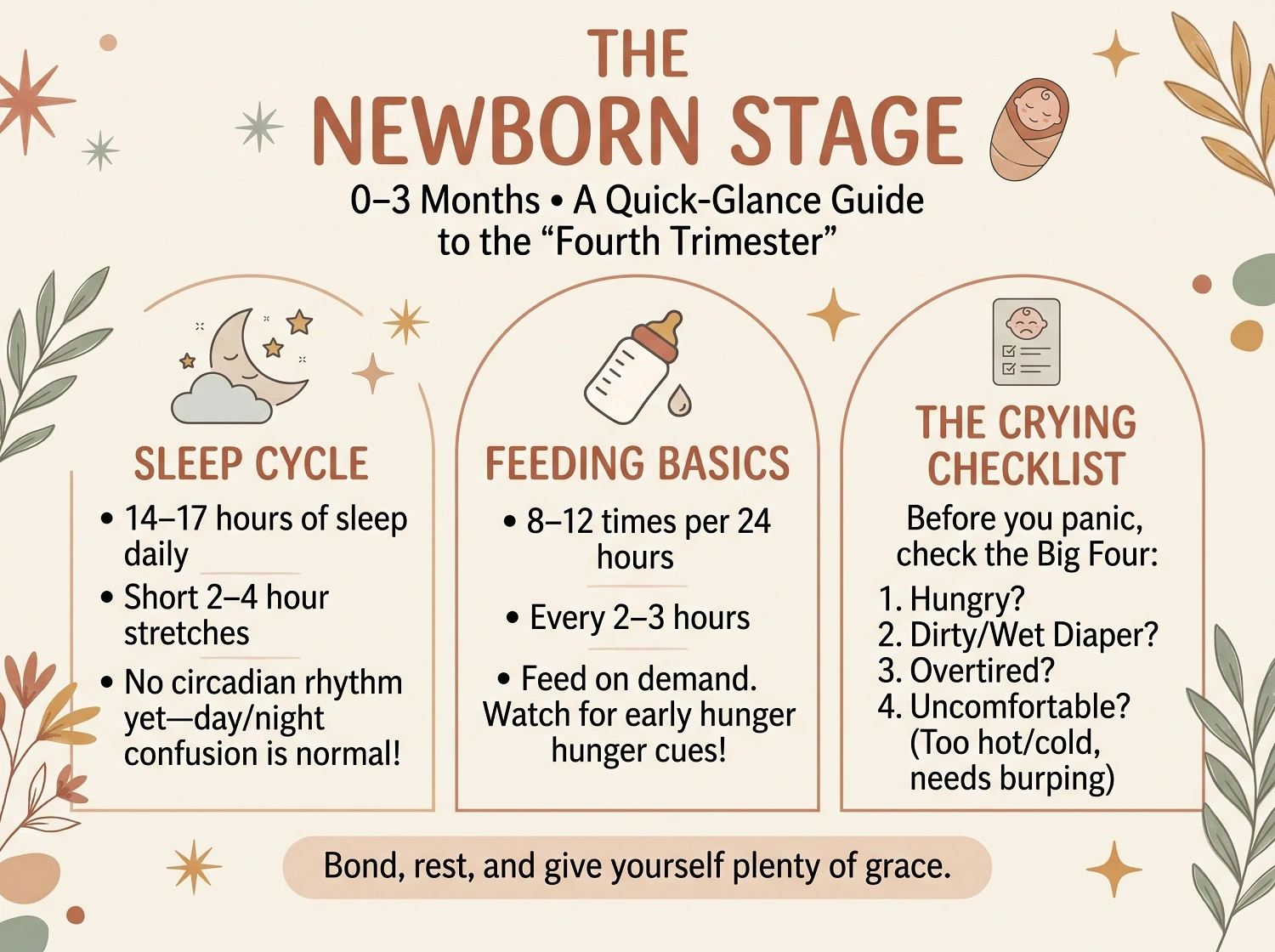
At home, the label is usually less exact. Families may continue calling a 6-, 8-, or even 12-week-old a newborn because the baby’s daily life still revolves around feeding, sleeping in short stretches, crying, diaper changes, and being held. The first 12 weeks are also often called the fourth trimester, an informal term for the adjustment period after birth.
Neither usage is wrong. The important point is context: when a doctor, medication label, hospital form, or care instruction uses an age limit, give your baby’s exact age rather than relying on the word “newborn.” If weeks and calendar months are becoming difficult to track, the baby age calculator can calculate your baby’s precise age from their birth date.
| Term | Typical age range | How it is commonly used |
|---|---|---|
| Newborn or neonate | Birth through day 27 | Medical care and health statistics |
| Newborn stage | Often birth through 8–12 weeks | Everyday parenting and early adjustment |
| Infant | Birth through the first year | Broader term that includes newborns |
These ranges overlap. A 2-week-old can accurately be described as a newborn, an infant, and a baby.
What the newborn stage looks like from week to week
No weekly timeline can predict an individual baby’s behavior, but the first three months often feel different in phases. Thinking in broad windows can be more useful than expecting a sharp ending.
Birth through the first week: recovery and adjustment
During the first days, the baby is adapting to breathing, feeding, temperature changes, light, sound, and life outside the uterus. Much of the day may appear to be a repeating loop of feeding, sleeping, diaper changes, and soothing.
New parents are also learning what their baby’s hunger cues, sleepy movements, cries, and normal noises look and sound like. Grunts, squeaks, sneezes, hiccups, irregular movements, and brief periods of alertness can all seem surprising when everything is new.
Early medical follow-up is important because feeding, hydration, jaundice, weight, and recovery after birth need to be assessed in context. Follow the discharge plan you were given rather than comparing your baby’s schedule with another newborn’s routine.
Weeks 2–4: still fully newborn, but more familiar
By the second and third weeks, the tasks may be the same, but caregivers often recognize patterns more quickly. You may notice early hunger signals before crying begins, a preferred soothing method, or a time of day when your baby tends to be more alert.
Sleep is still spread across day and night. Frequent waking is expected because young babies need regular feeding and do not yet organize sleep like older children or adults. A long stretch of sleep is not a required sign of progress, and feeding instructions from your baby’s clinician take priority over attempts to create a schedule.
At the end of week four, the medical newborn period is complete. That label change does not mean your baby should suddenly sleep longer, cry less, or settle without help.
Weeks 5–8: more alertness and early social responses
During the second month, many babies spend a little more time looking at faces, reacting to voices, and moving with purpose. The CDC’s 2-month milestones include looking at a caregiver’s face, reacting to loud sounds, making sounds besides crying, and beginning to smile in response to interaction. (CDC 2-month milestones) Use them as a starting point for conversations with your pediatrician about development. You can use the baby milestone tracker to review age-based skills without treating them as a test.
Fussiness may also feel intense during this window. A baby can become more awake before becoming better at settling, which means longer alert periods do not always make the day easier. Support from another adult can be especially useful when feeding and soothing still occupy much of the day.
Weeks 9–12: the fourth trimester begins to close
Around the third month, many families notice that the day no longer feels quite as newborn as it did during week two. The baby may make more eye contact, respond socially, hold their head more steadily for short periods, stay awake longer, or show clearer preferences.
These shifts often happen one at a time. A baby might smile and engage more while still waking frequently. Another may have slightly longer sleep stretches but remain fussy in the evening. Reaching 12 weeks does not create a reliable schedule or remove the need for close care.
Signs your baby is moving beyond the newborn stage
The end of the newborn stage usually arrives as a collection of small changes. You may notice that your baby:
- spends longer periods quietly awake
- focuses more consistently on faces or nearby objects
- responds to familiar voices and interaction
- begins smiling socially rather than only during sleep
- has somewhat more recognizable feeding and sleeping patterns
- holds their head a little more steadily when supported
- uses different sounds or movements to signal different needs
Not every sign will appear at once, and none is required before you can stop using the word “newborn.” Development is influenced by gestational age, health, temperament, feeding, and many other factors.
If your baby was born prematurely, use corrected age when your pediatrician recommends it. Corrected age subtracts the number of weeks your baby was born early from their chronological age and can provide a more appropriate frame for discussing development during the first two years.
What does not automatically change when the newborn stage ends
Leaving the newborn period does not guarantee that parenting becomes predictable. Many normal early-infant needs continue well beyond the first month or first 12 weeks.
Sleep may remain fragmented
Young babies do not need to sleep through the night to be healthy. Their sleep can vary with feeding, growth, illness, stimulation, and individual development. The baby sleep calculator can help families visualize a flexible day later in infancy, but it should not be used to delay feeding or force a young baby to stay awake.
Safe-sleep guidance also remains the same. Place your baby on their back for every sleep on a firm, flat, non-inclined surface in a safety-approved crib, bassinet, portable crib, or play yard. Keep pillows, loose blankets, toys, bumpers, and other soft items out of the sleep space. The AAP recommends room-sharing without bed-sharing for at least the first 6 months.
Feeding remains responsive and individual
A 1-, 2-, or 3-month-old may still feed frequently around the clock. Follow your baby’s hunger and fullness cues along with any feeding plan provided by the pediatrician, lactation professional, or other clinician involved in their care.
Growth, birth history, breast or bottle feeding, and health conditions can all affect feeding advice. Do not dilute formula, depart from its preparation instructions, add cereal to a bottle, or stretch time between feeds to encourage longer sleep unless a qualified clinician has given specific directions.
Crying does not end on a calendar
Crying is how babies communicate, and it continues well past the newborn phase. Babies cry from hunger, tiredness, discomfort, overstimulation, or a need for closeness, and sometimes for no obvious reason at all.
When you feel overwhelmed, place the baby on their back in a safe sleep space and step away briefly to regain control. Ask another trusted adult for help when available. Never shake a baby.
The newborn stage for parents and caregivers
For adults, the stage often feels longer than the medical 28-day definition. Physical recovery, disrupted sleep, feeding concerns, changing household roles, and the responsibility of caring for a fully dependent baby do not disappear at one month.
It can be more realistic to measure progress by what has become familiar. Perhaps diaper changes no longer require every supply to be arranged perfectly. You may recognize an early feeding cue, know which swaddle or sleep sack fits, or feel more comfortable calling the pediatrician with a question. These small gains matter even if the days remain demanding.
Visitors and outside expectations can make this period harder. Protecting time for feeding, rest, medical appointments, and quiet adjustment is reasonable. A household does not need to return to its pre-baby rhythm by 6 weeks or any other socially convenient deadline.
Postpartum mental health also deserves attention. Persistent sadness, panic, hopelessness, frightening thoughts, or feeling unable to care for yourself or the baby should not be dismissed as simply part of the newborn stage. Contact a healthcare professional promptly; seek emergency help if there is an immediate risk of harm.
When a young baby needs medical attention
Newborns and young infants can become ill quickly, so age-specific advice matters more than the informal end of the newborn phase.
Call your pediatrician immediately if a baby younger than 3 months has a rectal temperature of 100.4°F (38°C) or higher, even if there are no other symptoms. Do not give fever medicine to a young baby unless a clinician directs you to do so.
Seek urgent medical care if your baby:
- has trouble breathing, pauses in breathing, or blue or gray lips or skin
- is unusually limp, unresponsive, or difficult to wake
- refuses repeated feeds or cannot keep feeds down
- has noticeably fewer wet diapers than expected for their age and feeding plan
- has worsening yellow skin or eyes, repeated forceful vomiting, or a seizure
- looks or behaves in a way that concerns you, especially during the first weeks
This information is educational and cannot assess an individual baby. If you are uncertain, contacting your baby’s healthcare professional is appropriate; you do not need to wait until a symptom fits a perfect description.
A stage that fades gradually
The simplest answer to “how long is the newborn stage?” is 28 days medically and roughly 8 to 12 weeks in everyday parenting language. Both timelines describe something useful, but neither predicts the exact day life will feel different.
The stage usually recedes through small changes: a longer gaze, a first social smile, a feeding cue you recognize, or an afternoon that feels slightly more manageable. Your baby remains an infant after the newborn period, still needing close care while gradually becoming more alert, responsive, and connected to the world around them.
